Hookups /
Campground Hookups Explained: 30 vs 50 Amp, Water, Sewer
Campground hookups explained: what 30 amp and 50 amp pedestals supply in watts, what water and sewer mean, and which national park campgrounds have none.
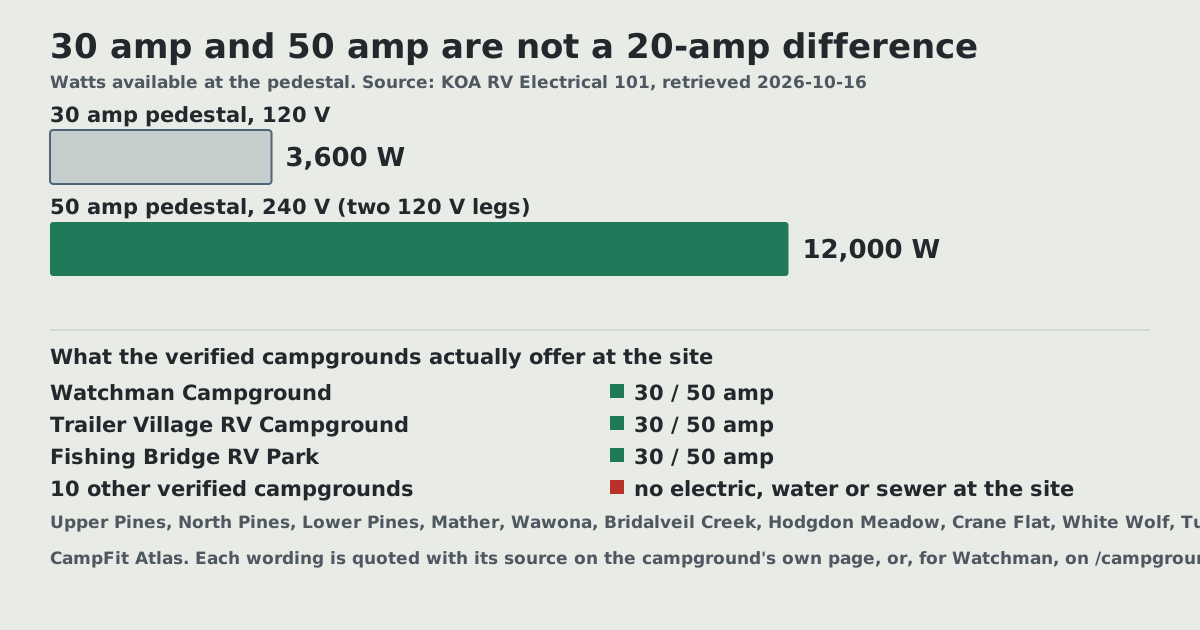
Campground hookups explained properly starts with one correction: the numbers on a pedestal are amps, your appliances are rated in watts, and the conversion between them is where most of the confusion lives. A second confusion follows close behind — in the national parks, the honest answer to "which hookups does this campground have" is very often "none".
This guide covers what each connection supplies, what the amperage numbers mean in watts, and what the campgrounds verified on this site actually offer.
The three connections
A campsite can offer up to three utilities, and the vocabulary is standardised enough to trust:
Electric. A pedestal with one or more outlets, rated in amps. Thirty amp and 50 amp are the common RV sizes; many pedestals also carry a household 20-amp outlet.
Water. A spigot at the site that you connect to with a drinking-water hose, letting you run taps without drawing from the fresh tank.
Sewer. A capped pipe at the site for the sewer hose, so grey and black tanks drain where you stand rather than at a shared station.
All three at one site is "full hookups". Electric and water is often called "partial". Electric alone is usually written just as "electric", and a site with nothing is "non-electric", "dry" or "primitive" depending on who is writing.
| Term | Electric | Water | Sewer | Typical wording |
|---|---|---|---|---|
| Full hookups | Yes | Yes | Yes | "full hookups for electricity, water, and sewer" |
| Partial | Yes | Yes | No | "water and electric" |
| Electric only | Yes | No | No | "standard electric" |
| Non-electric | No | No | No | "no electric, water or sewer hook-ups" |
Recreation.gov uses the site-type phrasings in that right column, and they appear verbatim on campsite pages: Watchman's A loop sites, for instance, are typed "STANDARD ELECTRIC", with an electric hookup listed as 30 and a water hookup listed as "No" on site A024.
30 amp and 50 amp, in watts
The amperage number alone is misleading, because the two services are not wired the same way.
A 30-amp RV service is a single 120-volt circuit. Thirty amps multiplied by 120 volts gives about 3,600 watts, which is the figure KOA's electrical guide uses (KOA, RV Electrical 101).
A 50-amp RV service is two 120-volt legs. The same guide gives the potential power as 12,000 watts, from 50 amps times 240 volts, and describes it as more than three times the possible demand of 30-amp service.
| Service | Volts | Amps | Watts available | Rough capability |
|---|---|---|---|---|
| 20 amp household | 120 | 20 | 2,400 | Charger, lights, a small appliance |
| 30 amp RV | 120 | 30 | 3,600 | One air conditioner, carefully |
| 50 amp RV | 240 (two legs) | 50 | 12,000 | Two air conditioners plus the rest |
The gap between rows two and three is the whole story. Going from 30 to 50 does not add two thirds; it more than triples. An RV built for 50 amps assumes two air conditioners, an electric water heater element, a residential refrigerator and an induction cooktop can coexist. On 3,600 watts they cannot.
Running a 50-amp rig on a 30-amp pedestal
This is the practical case, because 50-amp sites are scarce and 30-amp sites are common. With a correct adapter it works, with a hard ceiling. The KOA guide puts the shortfall at about one third of the power a 50-amp rig may need for a full set of appliances, and adds a warning worth repeating: running heavy loads such as heaters and air conditioners can push the breaker's trip point above 4,000 watts, and a 30-amp plug can be burned up because it is not designed to carry that kind of wattage. Its advice is to use 50-amp service where it exists and to limit power use on 30.
In practice that means one air conditioner, the water heater on propane rather than electric, the refrigerator on propane or on its energy-saving setting, and no induction cooking while the air conditioner runs. The adapter does not create power; it only changes the shape of the plug.
Zion's Watchman Campground is a good illustration of why this matters. Its Recreation.gov facility page states that standard electric sites in A and B loops may be used for either tent or RV camping, that electric sites are all 30 amp with only a handful of sites that supply 50 amp, and that there are no full-hookup campsites (Watchman Campground). A 50-amp rig that books Watchman is, in all likelihood, spending the week on 30 amp.
Most national park campgrounds have nothing
This is the part that catches first-time park visitors, and the official wording is not ambiguous.
The National Park Service states flatly that no campsites in Yosemite have hook-ups of any kind (NPS Yosemite campgrounds, page last updated September 28, 2026). Recreation.gov repeats it per campground: there are no electric, water or sewer hook-ups available at individual campsites at Upper Pines, and the same sentence appears for North Pines.
Grand Canyon's Mather Campground is equally direct: the page says Mather does not have hookups, across 327 campsites at about 7,000 feet, and lists no electric, sewer or water hookups (Mather Campground).
Where hookups do exist inside a park, they tend to be concentrated in one purpose-built RV area, often run by a concessioner rather than the Park Service:
| Campground | Electric | Water | Sewer | Wording source |
|---|---|---|---|---|
| Upper Pines, Yosemite | None | None | None | Recreation.gov facility page |
| North Pines, Yosemite | None | None | None | Recreation.gov facility page |
| Lower Pines, Yosemite | None | None | None | NPS Yosemite campgrounds |
| Mather, Grand Canyon | None | None | None | Recreation.gov facility page |
| Watchman, Zion | 30 amp, few 50 | No | No | Recreation.gov facility page |
| Trailer Village, Grand Canyon | 30 and 50 amp | Yes | Yes | NPS Trailer Village |
| Fishing Bridge RV Park, Yellowstone | 30 or 50 amp | Yes | Yes | Yellowstone National Park Lodges |
Trailer Village describes itself as the only in-park RV campground with full hookups, including sewage, water and electrical, with electrical in 30-amp and 50-amp options, on paved pull-through sites accommodating vehicles up to 50 feet, open year-round and run by Delaware North (NPS Trailer Village).
Fishing Bridge RV Park lists full hookups for electricity, water and sewer at 50 amp or 30 amp across 310 sites for hard-sided recreational vehicles only, with 110-volt service alongside the 50- and 30-amp service in the Upper Loop (Yellowstone National Park Lodges).
What your appliances actually draw
The watt figures above only become useful next to the loads you carry. Treat these as the order of magnitude rather than your rig's exact spec sheet, and look up your own nameplates before you plan a week on 30 amp.
| Appliance | Typical running draw | Share of a 3,600 W pedestal |
|---|---|---|
| Air conditioner, 13,500 BTU | 1,300–1,800 W | Roughly half |
| Electric water heater element | 1,400 W | Roughly 40% |
| Microwave | 1,000–1,500 W | Roughly a third |
| Residential refrigerator | 150–800 W | Up to a fifth |
| Induction burner | 1,300–1,800 W | Roughly half |
| Converter charging batteries | 300–600 W | Under a fifth |
| Lights, fans, electronics | 50–200 W | Negligible |
Add the first three rows and a 30-amp pedestal is already full. That is the arithmetic behind the standard advice: on 30 amp, put the water heater and the refrigerator on propane, run one air conditioner, and do not microwave while the compressor is starting. Starting surges are the hidden part — an air conditioner compressor draws several times its running wattage for a moment at startup, which is why a pedestal that has been fine all afternoon trips when the second appliance kicks in.
On 12,000 watts the same list fits with room to spare, which is exactly what a 50-amp coach is designed around.
Pedestal etiquette and the things that go wrong
Four failure modes come up repeatedly, and three are avoidable before you leave.
The wrong adapter, or none. A 50-amp rig needs a 50-to-30 adapter to use a 30-amp outlet, and a 30-amp rig needs a 30-to-20 adapter for a household outlet. Carry both. An adapter changes the plug shape and nothing about the supply.
Assuming 50 amp exists because the campground lists it. Watchman lists 30 amp at all electric sites with only a handful supplying 50. A campground-level mention of 50 amp is a statement about a few sites, and the individual campsite page is where your site's own figure lives.
Assuming electric means water. Watchman's electric sites list a water hookup of "No" on the campsite page, and the facility page says there are no full-hookup campsites. Electric and dry is a normal combination.
Forgetting the season. A dump station or a water spigot can be shut off for freezing weather while the campground stays open. Fishing Bridge says as much about its own dump station. A utility listed in July is not a utility promised in May.
Dump stations and potable water
Without a sewer hookup, the shared dump station is the whole sanitation plan, and its location and season are worth knowing before arrival.
Upper Pines has a free dump station on site along with potable water, and the National Park Service lists it as available all year, which makes it the Yosemite Valley answer: North Pines points to the free dump station and drinking water nearby at Upper Pines rather than having its own. Mather points to a free dump and water fill station at Camper Services. Watchman has a dump station with potable water at the campground entrance. Fishing Bridge has an RV dump station near the entrance, with the caveat that it may not be available early and late season due to freezing temperatures — a reminder that a utility listed on a page is not always a utility available in October.
Generators, the hookup substitute
On a non-electric site a generator is the alternative, and generator rules are campground-specific and sometimes loop-specific:
- Watchman, Zion: generators are not allowed in the campground.
- Mather, Grand Canyon: not permitted in Pine Loop, sites 265 to 319, during peak season; elsewhere 7:00 to 9:00 a.m. and 6:00 to 8:00 p.m. only. In winter, Pine Loop allows them during those same hours.
- Fishing Bridge RV Park, Yellowstone: allowed 8:00 a.m. to 8:00 p.m., not exceeding 60 decibels at 50 feet, with quiet hours 10:00 p.m. to 6:00 a.m.
The decibel limit at Fishing Bridge is the useful detail: it is a specification you can check against your generator's datasheet before you leave home, rather than a judgement call at the site.
Booking around a missing hookup
A non-electric site is not a problem to solve at the pedestal; it is a problem to solve before you book. Four levers, roughly in order of how much they change the trip:
Choose the campground for the utility, not the park for the campground. At Grand Canyon's South Rim the two in-park choices sit minutes apart and are opposites: Mather with no hookups at all and 327 sites, Trailer Village with full hookups on paved pull-throughs. If power is the constraint, that decision is made at the booking screen.
Match the loop, not just the campground. Watchman's A and B loops carry electric; C and D are non-electric standard sites; E and F are tent-only. One campground, four different answers, and the loop is visible in the site number before you reserve.
Plan the propane side. Every national park campground in the table above that has no electric still permits a propane water heater and a propane refrigerator. The practical difference between a comfortable dry week and an uncomfortable one is usually whether the tanks were full on arrival, not whether the pedestal existed.
Know the dump station before the tanks are full. Where it is, whether it is free, and whether it is open in your month. The Yosemite Valley answer is Upper Pines all year; the Mather answer is Camper Services; the Watchman answer is the campground entrance.
Reading a hookup claim
Three habits keep this straightforward:
- Prefer the campground's own page over a directory. Hookup status changes with construction, and a park page or a Recreation.gov facility page is the thing that gets updated.
- Note whether the claim is per-site or per-campground. "Electric sites are all 30 amp, with only a handful of sites that supply 50 amp" describes a distribution, not a guarantee for your site. The individual campsite page carries that site's own electric field.
- Treat silence as absence, not as permission. If a page does not mention sewer, plan for the dump station. Every campground page here prints the exact hookup sentence it found and says "not stated" where the official page says nothing.
If power is your constraint rather than length, the two still interact: the full-hookup options in these parks are also the longest sites, which is why it is worth running your rig through the fit calculator against a 50-foot pull-through as well as a 35-foot back-in. Campground hookups explained in one line: find out the amperage before you arrive, assume no water and no sewer in a national park campground unless a page says otherwise, and know where the dump station is.
Frequently asked questions
What is the difference between 30 amp and 50 amp campground hookups?
A 30-amp pedestal is a single 120-volt circuit supplying about 3,600 watts. A 50-amp pedestal supplies about 12,000 watts, calculated as 50 amps at 240 volts across two 120-volt legs. The step from 30 to 50 is therefore more than triple the available power, not a 67% increase, which is why a 50-amp rig on a 30-amp pedestal has to run far fewer appliances.
Can I plug a 50-amp RV into a 30-amp outlet?
With the correct adapter, yes, and with much less power: roughly one third of what the rig may want. KOA's electrical guide warns that running heavy loads such as heaters and air conditioners can push demand above 4,000 watts, beyond the breaker's trip point, and that a 30-amp plug can be burned up because it is not designed to carry that wattage. Plug in, then run one air conditioner at a time.
What does full hookups mean?
Full hookups means electric, water and sewer connections at the individual site, so you can stay connected without moving the rig. Trailer Village at Grand Canyon describes itself as the only in-park RV campground with full hookups of sewage, water and electrical, in 30-amp and 50-amp options. Fishing Bridge RV Park in Yellowstone also lists full hookups for electricity, water and sewer at 50 or 30 amp.
Do national park campgrounds have hookups?
Mostly not. The National Park Service states plainly that no campsites in Yosemite have hook-ups of any kind, and Grand Canyon's Mather Campground states it does not have hookups at all. Where hookups exist in a park they are usually in one dedicated RV area, such as Trailer Village at Grand Canyon or Fishing Bridge RV Park at Yellowstone, often run by a concessioner.
What is a dump station and do I need one if there are no hookups?
A dump station is a shared sewer connection for emptying holding tanks, usually near a campground entrance. Upper Pines in Yosemite has a free dump station on site with potable water, serving the Yosemite Valley campgrounds, and Mather Campground points to a free dump and water fill station at Camper Services nearby. Without a sewer hookup at your site, the dump station is how the trip ends.
Are generators allowed instead of hookups?
It depends on the campground and often on the loop. Zion's Watchman Campground does not allow generators at all. Mather Campground restricts them to 7:00 to 9:00 a.m. and 6:00 to 8:00 p.m., and bans them entirely in Pine Loop during peak season. Fishing Bridge RV Park allows them from 8:00 a.m. to 8:00 p.m. and caps them at 60 decibels at 50 feet.