35 Foot RV National Park Campsites: How to Find Them
35 foot RV national park campsites: how to filter Recreation.gov by length, what the length field measures, and six campgrounds with limits from the parks.
Searching for 35 foot RV national park campsites turns up plenty of listicles and very little that survives contact with a reservation screen. The reason is simple: nobody can publish a durable list of sites that fit a given length, because the limits are per-campground and sometimes per-site, they change with repaving and tree growth, and availability changes every morning. What can be published is the method, plus the limits that are verifiable right now.
This guide is the method, with six campgrounds as worked examples and no claim that any of them has a site open.
Start from the official length field, not a list
Recreation.gov is the booking system for the federal campgrounds in this set, and it holds the length data the parks publish. Four fields matter, and they are not interchangeable:
| Field | Where it appears | What it means |
|---|---|---|
| Maximum RV length | NPS campground tables, facility pages | The longest motorhome the campground accepts |
| Maximum trailer length | NPS campground tables, campsite pages | The longest towed unit accepted, usually lower |
| Driveway length | Individual campsite pages | The measured parking spur on that site |
| Permitted equipment | Individual campsite pages | A maximum length per equipment type, booked against |
The permitted-equipment list is the field a reservation is actually checked against, and it is the one most searchers never open. Site 214 at Upper Pines in Yosemite permits an RV at 27 feet, a pickup camper at 27 feet and a camper van at 27 feet, but a trailer or pop-up at only 18 feet. The page states the rule behind the spread — the maximum trailer length is always shorter than the maximum RV length because of maneuverability — and warns that if you arrive with different equipment than you booked you will likely not fit and will be turned away.
That warning is why "35 feet" has to be matched to an equipment type before it means anything. A 35-foot motorhome and a 35-foot trailer behind a truck are two different bookings.
How to filter, step by step
- Measure the rig as it travels. Not the brochure length. For a motorhome with nothing behind it, the coach. For a trailer, the trailer alone and the hitched pair, because you will need both numbers. The fit calculator does the addition and draws the result.
- Search the park or campground on Recreation.gov, rather than a nationwide "RV sites" search. Length limits belong to campgrounds, so the campground is the right unit of search.
- Set the equipment type and length in the filters before choosing dates. Picking dates first hides sites that are unavailable rather than too short, which mixes the two problems you are trying to separate.
- Open the facility page and read the length statement in prose. The structured filter is built on records; the prose often carries the exception. Mather's facility page is the example: a 30-foot limit for motorhomes or trailers across 327 campsites, and then the detail that sites 120, 121, 128, 172 and 185 fit a 30-foot trailer while other sites will not (Mather Campground).
- Open individual campsite pages for the sites you are considering. Read driveway length, driveway entry, surface and the permitted-equipment line. A driveway length of 0 means the field was never populated, not that the spur is zero feet long.
- Check the approach road separately. Zion publishes a restriction for the Zion-Mt. Carmel Highway: from June 7, 2026, vehicles over 35 feet 9 inches long, 11 feet 4 inches tall or 7 feet 10 inches wide cannot travel it, and large vehicles must enter and exit through the South Entrance in Springdale (Watchman Campground). A 35-foot rig clears that length limit by nine inches; a 36-foot one does not, whatever the campsite says.
- Book the equipment you will arrive with, and leave margin on the spur.
Six campgrounds, limits read from the official pages
Every figure below was read from the official page cited beside it on the retrieval date shown on each campground page. None of this is an availability claim.
| Campground | Park | Published limit | A 35 ft rig | Hookups |
|---|---|---|---|---|
| Mather | Grand Canyon, South Rim | 30 ft motorhome or trailer | Outside the limit | None |
| Upper Pines | Yosemite | 35 ft RV, 24 ft trailer | At the RV limit exactly | None |
| North Pines | Yosemite | 40 ft RV, 35 ft trailer | Inside both | None |
| Lower Pines | Yosemite | 40 ft RV, 35 ft trailer | Inside both | None |
| Trailer Village | Grand Canyon, South Rim | 50 ft pull-through | Inside | Full, 30 and 50 amp |
| Fishing Bridge RV Park | Yellowstone | 95 ft combined | Inside | Full, 30 or 50 amp |
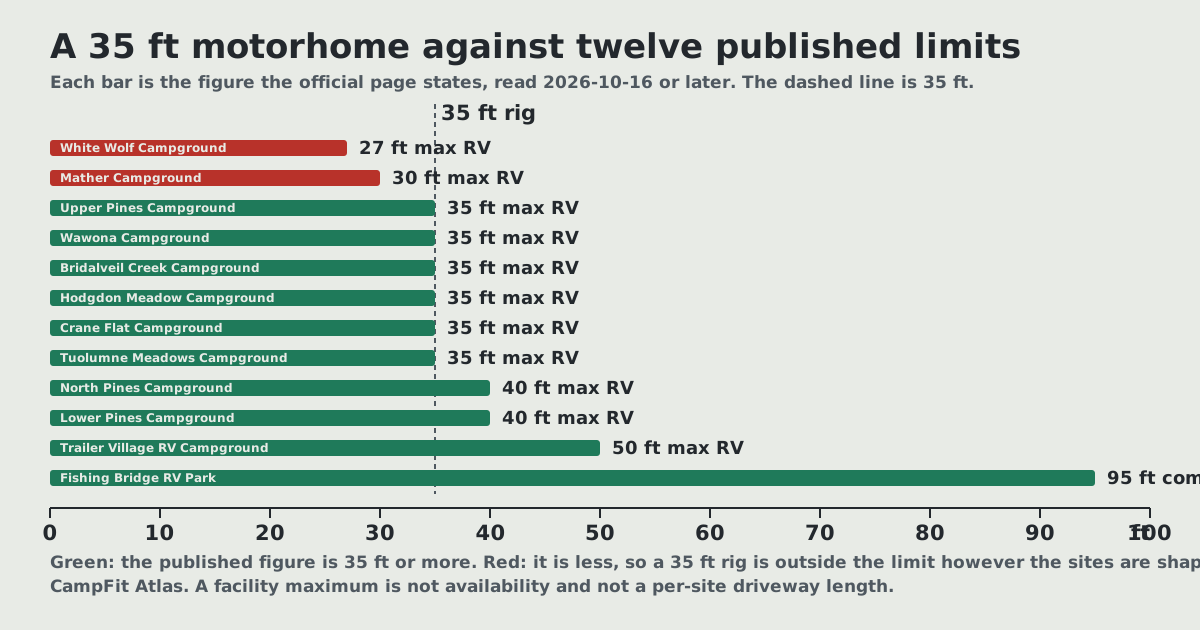
The hero diagram draws those limits to one scale with the 35-foot mark as a dashed line, which makes the shape of the problem obvious: the limit is binding at exactly one of the six.
Mather is the clean no. Thirty feet is the published figure, and a 35-foot motorhome is outside it before any site-level question arises. The campground has 327 sites at about 7,000 feet, peak season from March 1 to November 30, winter reservations December 1 to February 28, no hookups, and a free dump station nearby at Camper Services. Generators are restricted to 7:00 to 9:00 a.m. and 6:00 to 8:00 p.m. and banned in Pine Loop during peak season.
Upper Pines is the interesting case: 35 feet is the ceiling, so a 35-foot motorhome is at it rather than under it. The campground has 236 sites at 4,000 feet, is open all year, and publishes a 24-foot maximum trailer length alongside the 35 (NPS Yosemite campgrounds, page last updated September 28, 2026). Recreation.gov adds that there are no electric, water or sewer hook-ups at individual campsites, that a free dump station with potable water is on site, and that sites are reservable up to five months ahead on the 15th of each month at 7:00 a.m. Pacific. Being at the ceiling means the site-level check matters more, not less — site 214's 27-foot cap is inside that same campground.
North Pines and Lower Pines publish 40 feet for an RV and 35 for a trailer, 81 and 74 sites respectively, both at 4,000 feet, open approximately April 21 to October 26 and April 21 to October 19. For a 35-foot motorhome these are the comfortable Yosemite Valley options; for a 35-foot trailer they are exactly at the trailer ceiling. North Pines was in an Early Access Lottery for the 2026 season; otherwise, Recreation.gov states, sites release up to five months in advance on the 15th of each month at 7:00 a.m. Pacific.
Trailer Village is the hookup answer at the South Rim: the National Park Service describes it as the only in-park RV campground with full hookups including sewage, water and electrical, with 30-amp and 50-amp options, on paved pull-through sites accommodating vehicles up to 50 feet, open year-round and operated by Delaware North (NPS Trailer Village).
Fishing Bridge RV Park publishes the largest figure of the six and the only explicitly combined one: up to 95 feet of RV plus tow vehicle based on the availability of the right-size site, across 310 sites for hard-sided units only, with full hookups for electricity, water and sewer at 50 or 30 amp, an Upper Loop of 172 paved sites from 40 to 95 feet and a Lower Loop of 30- to 35-foot gravel back-ins. The 2026 season runs May 8 to October 18 and the 2027 season May 14 to October 17, and from 2027 reservations move to Recreation.gov with individual site selection about six months ahead (Yellowstone National Park Lodges).
Why 35 feet is the awkward number
Thirty-five feet sits on a boundary, and the boundary is historical rather than arbitrary. The valley-floor and canyon-rim campgrounds were laid out when a large trailer was twenty feet, so their spurs and loop radii were sized for that era and have been resurfaced rather than rebuilt. Purpose-built RV areas, mostly concessioner-run and much newer, were designed around coaches in the forties and fifties of feet and towed cars behind them.
The six campgrounds above fall cleanly into those two groups. The four Park Service campgrounds publish 30, 35, 40 and 40 feet and no hookups of any kind. The two RV parks publish 50 feet and 95 feet combined, both with full hookups. A 35-foot rig is the first size at which the older group starts closing and the newer group becomes worth the extra cost.
Three practical consequences follow for anyone at or near 35 feet.
The trailer limit bites before the RV limit. Upper Pines publishes 35 feet for an RV and 24 for a trailer. A 35-foot fifth wheel is not an edge case there; it is eleven feet outside the published trailer figure, even though 35 is "the limit" people repeat. North Pines and Lower Pines publish a 35-foot trailer figure, which makes them the Valley answer for a 35-foot towed unit.
Unhitching changes the question, not the limit. Splitting the pair helps with a spur. It does not move a campground-wide maximum: a 40-foot trailer is outside a 35-foot trailer limit whether or not the truck is parked elsewhere.
Nine inches can decide a route. Zion's highway restriction at 35 feet 9 inches is the kind of number that makes a 35-foot rig legal and a 36-foot rig a detour. Length limits on roads are published separately from campgrounds and are the most commonly missed constraint of all.
Three searches worth running before you book
The reservation system rewards a few specific habits, and each one takes a minute.
Search the campground, then the park, then the region — in that order. Starting at a region returns hundreds of records whose length fields vary in quality. Starting at a named campground gets you to the facility page, where the prose exceptions live.
Run the search twice, once with your hitched length and once with the trailer alone. The difference between the two result sets is exactly the set of sites where unhitching is the deciding factor, which is useful to know before you are standing on the loop road deciding.
Check the season as carefully as the length. Of these six, Upper Pines and Trailer Village are the two the official pages call open all year; North Pines and Lower Pines run roughly late April into October; Mather splits into a peak season from March 1 to November 30 and winter reservations from December 1 to February 28; Fishing Bridge runs May 8 to October 18 in 2026. A perfect length match in a closed month is not a match.
One more habit that costs nothing: read the reservation window. Yosemite Valley campsites release five months ahead on the 15th of each month at 7:00 a.m. Pacific, Mather opens six months ahead, and Fishing Bridge joins Recreation.gov for the 2027 season at about six months. Knowing the release mechanic matters more than any list, because at these campgrounds the constraint is usually competition rather than geometry.
What a verified limit still does not tell you
A published limit answers one question and leaves four open.
Whether a long site exists on your dates. It does not, and no cached number can. Availability lives on the reservation system at the moment you look.
Whether every site is that long. Almost never. Mather's five named 30-foot sites out of 327 is the arithmetic in its sharpest form.
Whether your combined length fits. A single-unit limit is not a combined limit. Only Fishing Bridge's 95 feet, among these six, is directly comparable to a truck-and-trailer total.
Whether the spur is a back-in. Site A024 at Watchman in Zion lists a 39-foot driveway, a 39-foot maximum vehicle length, 30-amp electric, no water hookup, and a paved back-in entry. A 39-foot back-in and a 39-foot pull-through are different driving problems at the same published number.
Zion's Watchman is also the honest gap in this set. Its hookups, loops, dump station and generator rules are all verifiable, and no official page states a campground-wide maximum RV length. So this site publishes no fit page for it, rather than promoting one campsite's 39 feet into a facility limit.
The approach that holds up
If you want a method that is still correct next season rather than a list that rots:
- Treat the campground's published figure as a filter and the campsite page as the answer.
- Match length to equipment type, and book the equipment you bring.
- Carry two numbers, hitched and unhitched, because unhitching is the biggest single lever on a tight spur.
- Read the prose on the facility page for the exceptions the filters miss.
- Check approach roads, tunnels and height limits separately from campground limits.
- Assume nothing about hookups in a national park campground unless the page says so; the hookups guide covers what the amperages mean.
Searching for 35 foot RV national park campsites works when you search by campground, verify by campsite page, and keep the length question separate from the availability question — and when a figure is not published, treat the gap as a gap rather than filling it with someone's guess.
Frequently asked questions
Which national park campgrounds take a 35 foot RV?
No list can answer that permanently, because limits change and availability changes daily. Of the campgrounds verified on this site, Upper Pines in Yosemite publishes 35 feet for an RV, North Pines and Lower Pines publish 40 feet, Trailer Village at Grand Canyon publishes 50 feet for pull-through sites, and Fishing Bridge RV Park in Yellowstone publishes up to 95 feet combined. Mather Campground at Grand Canyon publishes 30 feet, so a 35-foot rig is outside its limit.
How do I filter Recreation.gov for a 35 foot RV?
Search the campground or area, then set the equipment type to RV and the length to 35 feet in the search filters before you pick dates. The filter matches against each site's permitted-equipment maximum lengths, so it removes sites whose records say they cannot take a 35-foot unit of that type. Sites with unpopulated length fields can still slip through, so open the site page and read the equipment line.
Does a 35 foot limit mean my 35 foot motorhome fits?
It means the campground accepts a unit that long, which is the first test. It does not mean every site is 35 feet, and it says nothing about a tow vehicle behind you. Mather Campground shows the difference: a 30-foot facility limit, with only five named sites listed as fitting a 30-foot trailer.
What does the length field on a campsite page measure?
Recreation.gov campsite pages carry several length fields: driveway length, which is the measured spur; max vehicle length, the longest single unit accepted; and permitted equipment, which lists a maximum length per equipment type. The equipment line is the one a booking is checked against, and the page states that the maximum trailer length is always shorter than the maximum RV length because of maneuverability.
Is a 35 foot RV too big for the national parks?
It rules out some campgrounds and not others, and the pattern is geographic rather than national. Valley-floor and canyon-rim campgrounds built in the 1950s tend to publish 30 to 40 feet; purpose-built RV areas publish 50 feet and more. A 35-foot rig is inside the published figure at five of the six campgrounds verified here, including at least one in every park; the one that rules it out is Mather, at 30 feet.