Campground Driveway Length vs RV Length: Which Fits
Campground driveway length vs RV length: one is a measured spur on one site, the other is the longest unit the campground accepts. How to read both.
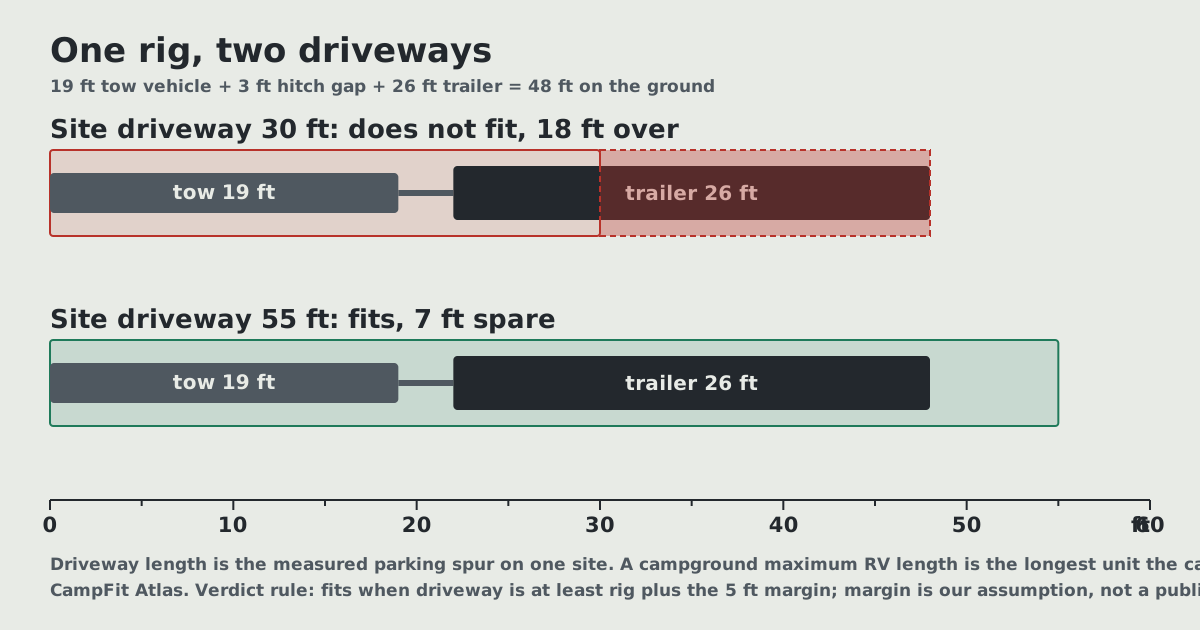
Campground driveway length vs RV length is the comparison that decides whether you are setting up or turning around, and the two numbers do not measure the same thing. One describes a patch of asphalt on one campsite. The other describes the longest unit the campground is willing to admit anywhere in it. Mixing them up is how a reservation that looked fine turns into a 40-point turn with a ranger watching.
This guide takes both numbers apart, shows where each one is published, and explains what to do when the number you need is missing.
The two numbers, defined
A driveway length is a measurement of one campsite's parking spur: the surface your rig actually sits on. It belongs to a single site, and it appears on Recreation.gov's individual campsite pages next to the driveway entry type (back-in or pull-through) and the surface (paved, gravel, dirt).
A maximum RV length or maximum vehicle length is a limit, not a measurement. It says what the campground, or that one site, will accept. It folds in things a tape measure on the spur never catches: how tightly the loop road turns, where the trees are, how wide the shoulder is, whether the spur is on a slope.
| Driveway length | Max RV / max vehicle length | |
|---|---|---|
| What it is | Measured parking surface on one site | The longest unit accepted |
| Scope | That campsite only | Sometimes a campground, sometimes one site |
| Includes maneuvering room | No | Yes, implicitly |
| Published on | Recreation.gov campsite pages | NPS campground pages, Recreation.gov facility and campsite pages |
| Missing-value convention | 0 means not measured |
Absent means no limit published |
| Useful for | Does my rig physically sit here | Am I allowed to bring this rig at all |
The distinction matters most in the gap between them. A 39-foot driveway with a 39-foot maximum vehicle length, which is what Recreation.gov lists for site A024 at Watchman Campground in Zion, tells you the limit is the spur itself. A 27-foot maximum vehicle length with the driveway field sitting at 0, which is what site 214 at Upper Pines in Yosemite shows, tells you the limit came from somewhere other than a tape measure, and the number you must respect is 27 regardless.
Why a campground maximum is not a per-site promise
Yosemite's campground table states a maximum RV length of 35 feet and a maximum trailer length of 24 feet for Upper Pines, across 236 sites at 4,000 feet, open all year (NPS Yosemite campgrounds, page last updated September 28, 2026). That 35 feet is the ceiling for the campground. It is not a claim that 236 sites each hold 35 feet. Site 214, one site inside that same campground, caps out at 27 feet for an RV and 18 feet for a trailer.
Grand Canyon's Mather Campground makes the same point even more bluntly. The facility limit is 30 feet for motorhomes or trailers across 327 sites, and the Recreation.gov facility page then names the five sites — 120, 121, 128, 172 and 185 — that fit a 30-foot trailer, adding that other sites will not fit one (Mather Campground). The campground maximum is real, and it is available on roughly 1.5% of the sites.
So the campground maximum is a filter, not a fit. It answers "should I even look here", and the per-site driveway length answers "can I park here". When you have only the campground number, you have passed the first test and learned nothing about the second.
The combined-length trap
Here is the failure that actually strands people. You read "maximum RV length: 35 feet", your travel trailer is 26 feet, and you book with confidence. Then you arrive with a 19-foot tow vehicle hitched three feet in front of it, and 48 feet of truck and trailer have to live on a spur sized for 35.
The hero diagram above is exactly that arithmetic: a 19-foot tow vehicle, a 3-foot hitch gap and a 26-foot trailer come to 48 feet on the ground. On a 30-foot driveway, 18 feet of it is somewhere else — usually the loop road. On a 55-foot driveway, the same rig fits with 7 feet spare.
Whether the campground's number covers the whole rig depends entirely on its wording, and the wording differs by park:
| Campground | Published figure | What it measures |
|---|---|---|
| Upper Pines, Yosemite | 35 ft RV, 24 ft trailer | Single units, measured separately |
| North Pines, Yosemite | 40 ft RV, 35 ft trailer | Single units, measured separately |
| Mather, Grand Canyon | 30 ft motorhome or trailer | Single unit, either kind |
| Trailer Village, Grand Canyon | 50 ft | Pull-through site capacity |
| Fishing Bridge RV Park, Yellowstone | 95 ft | RV plus tow vehicle, combined |
Fishing Bridge is the only one of those that is explicitly combined: the concessioner states the park accommodates RVs and tow vehicles up to 95 feet based on the availability of the right-size site, with the Upper Loop's 172 paved sites ranging from 40 to 95 feet and the Lower Loop offering 30- to 35-foot gravel back-ins, and it asks you to include the combined length of the RV and any towed vehicle when you reserve (Yellowstone National Park Lodges). Everywhere else in that table, you have to add your own vehicles up and then decide whether the single-unit limit applies to the piece you are parking or to the whole train.
The RV fit calculator does the addition and draws the result against whatever driveway length you type, including the unhitched case where the tow vehicle parks off the spur.
Where to find the driveway length
Recreation.gov publishes site-level fields on each individual campsite page. The ones worth reading, in the order they matter:
- Driveway Length — the measured spur, in feet. A 0 means unmeasured.
- Driveway Entry — back-in or pull-through. A back-in of the same length is harder, and sometimes impossible with a long tow vehicle still attached.
- Driveway Surface — paved, gravel or dirt. Gravel after rain changes what a heavy rig can do on a slope.
- Max Vehicle Length — the site's own ceiling.
- Permitted Equipment — a list of equipment types, each with its own maximum length. This is the most useful field on the page and the one most people skip.
That equipment list is where the real answer hides. Site 214 at Upper Pines permits an RV at 27 feet, a pickup camper at 27 feet and a camper van at 27 feet, but a trailer or pop-up at only 18 feet. One site, three different limits, depending on what you bring. Watchman site A024 is the opposite case: RV, trailer, pickup camper, pop-up, fifth wheel, camper van and car are all permitted at 39 feet, matching the 39-foot driveway exactly.
Recreation.gov also states the consequence plainly on its site pages: equipment is mandatory when booking, and if you arrive with different equipment than you booked you will likely not fit and will be turned away. The equipment field is not a preference. It is the reservation.
What to do when the number is missing
Three missing-data cases come up constantly, and each has a different workaround.
Driveway length is 0. Fall back on the maximum vehicle length and the permitted equipment lengths on the same page. They are limits rather than measurements, which means they already account for maneuvering, so they are conservative in the right direction.
The campground publishes no maximum at all. Zion's Watchman Campground is the example on this site. The National Park Service page for Zion camping gives the season and the reservation window and no length limit; the Recreation.gov facility page gives loop layout, amperages, a dump station and generator rules, and still no campground-wide maximum. What it does give is a floor from the other direction: tent-only F loop and non-electric C and D loop sites do not permit vehicles 19 feet and over, or 19 feet and over in combined length (Watchman Campground). That is a restriction on specific loops, not a campground maximum, so CampFit Atlas does not publish a Watchman fit page at all — a single site's 39 feet is not a facility limit, and inventing one would be worse than leaving the gap visible.
The road is the limit, not the campsite. Watchman supplies this example too. From June 7, 2026, vehicles over 35 feet 9 inches long, 11 feet 4 inches tall or 7 feet 10 inches wide cannot travel the Zion-Mt. Carmel Highway, and large vehicles must enter and exit through the South Entrance in Springdale. A rig can fit the spur perfectly and still be unable to reach it from the direction you planned. Length limits on approach roads, tunnels and switchbacks are published separately from campground limits and are easy to miss.
Back-in, pull-through, and why the same number is not the same site
Two sites can publish the same driveway length and be completely different problems. Driveway entry is the field that separates them, and Recreation.gov states it on every campsite page.
A pull-through spur is entered at one end and left at the other. Nothing has to be reversed, the tow vehicle stays hitched, and the published length is close to usable length. Trailer Village at Grand Canyon is built this way: the National Park Service describes paved pull-through sites accommodating vehicles up to 50 feet, in the only in-park RV campground with full hookups of sewage, water and electrical service (NPS Trailer Village).
A back-in spur has one opening. The rig reverses in off the loop road, which means the loop road is temporarily part of your maneuvering space, and the geometry of the opposite shoulder matters as much as the spur itself. Both of the site examples in this guide are back-ins: Upper Pines site 214 and Watchman site A024 are each listed as paved, back-in entries. A 39-foot back-in and a 39-foot pull-through are not interchangeable, and no published number captures the difference.
Fishing Bridge RV Park splits its loops along exactly this line. The concessioner describes the Upper Loop's 172 paved sites, ranging 40 to 95 feet, as mostly including pull-through drives, while the Lower Loop is 30- to 35-foot gravel back-ins, some of them single-width. Same campground, same reservation system, two very different driving tasks.
The practical rule: on a back-in, treat the published length as the ceiling rather than the target, and if you are near the ceiling, consider unhitching. On the fit calculator the unhitched case parks the tow vehicle off the spur, so only the trailer has to fit the driveway, which is often the difference between "does not fit" and "fits".
What the length limit cannot tell you
A fit verdict from arithmetic is a necessary condition, not a sufficient one. Four things stay invisible in every published length field:
Width. Site width is almost never published. CampFit Atlas reports your width with slides extended and refuses to judge it, because there is nothing authoritative to judge it against. A single-width gravel back-in, as some Lower Loop sites at Fishing Bridge are described, is a width constraint stated in words rather than feet.
Height and overhead clearance. Trees grow. Zion publishes a height limit of 11 feet 4 inches for the Zion-Mt. Carmel Highway; campground loops publish nothing comparable, and a spur that measures long enough can still have a branch at 11 feet.
Slope and levelling. A long spur on a grade costs length, because levelling blocks and jacks move the rig. Nothing in the data captures this.
Who is next door. A neighbour parked a foot over the line changes your available width, and in a back-in, your swing.
A short checklist before you book
- Add your rig up as it travels: tow vehicle, hitch gap, trailer. For a fifth wheel, subtract the overlap over the truck bed. For a motorhome with a car behind it, add the tow bar gap and the car.
- Read the campground maximum and note which unit it measures.
- Open the specific campsite page and read driveway length, entry type, surface and the permitted-equipment line for your equipment type.
- Book the equipment you will actually arrive with.
- Leave yourself margin. On the fit calculator that defaults to 5 feet, which is enough to keep the tow vehicle's nose off the loop road; it is our assumption and you can change it.
- Check the approach road's own limits, not just the campground's.
Two numbers, two questions
Campground driveway length vs RV length comes down to this: the driveway length tells you whether your rig sits on the pad, and the maximum RV length tells you whether the campground will have you at all. You need both, they are published in different places, and when either is missing the honest move is to use the conservative one and say so rather than to average a guess. Every campground page here quotes the exact sentence its numbers came from, and the methodology lists every source and the date it was read — because on campground driveway length vs RV length, the wording is the data.
Frequently asked questions
What is the difference between driveway length and max vehicle length?
Driveway length is the measured parking surface on one specific campsite. Max vehicle length is the longest single unit that site or campground will accept, which also reflects how the loop road turns and what the site is shaped like. On Recreation.gov a site can show a 39-foot driveway and a 39-foot max vehicle length, as Watchman site A024 does, or a 27-foot max vehicle length with the driveway listed as 0, as Upper Pines site 214 does.
Why does Recreation.gov show a driveway length of 0?
A zero means the field was never populated for that site, not that the site has no driveway. Upper Pines site 214 lists driveway length 0 alongside a stated 27-foot maximum vehicle length and a paved, back-in entry, so the driveway clearly exists. Treat 0 as unmeasured and use the maximum vehicle and equipment lengths on the same page instead.
Does the campground maximum RV length include my tow vehicle?
Not unless the source says so. Yosemite publishes a maximum RV length and a separate maximum trailer length for each campground, both measured as single units. Fishing Bridge RV Park in Yellowstone publishes a combined figure instead, up to 95 feet for RV plus tow vehicle, and asks for the combined length at the time of booking. Read the wording, not just the number.
Why is the maximum trailer length lower than the maximum RV length?
Recreation.gov's own campsite pages state that the maximum trailer length is always shorter than the maximum RV length because of maneuverability. A towed trailer pivots, cuts the corner and needs the tow vehicle somewhere while it backs, so a 35-foot motorhome can use a spur that a 35-foot trailer cannot.
How much extra driveway should I plan for?
CampFit Atlas uses a 5-foot margin by default so the tow vehicle's nose stays off the loop road and the rear door opens over gravel rather than asphalt. That number is an editorial assumption, not a published standard, and the fit calculator lets you set it to zero or to whatever your own experience says.