RV Trailer Combined Length Campsite Fit, Measured
RV trailer combined length campsite fit: add tow vehicle, hitch gap and trailer, subtract fifth-wheel overlap, then compare it to the right park limit.
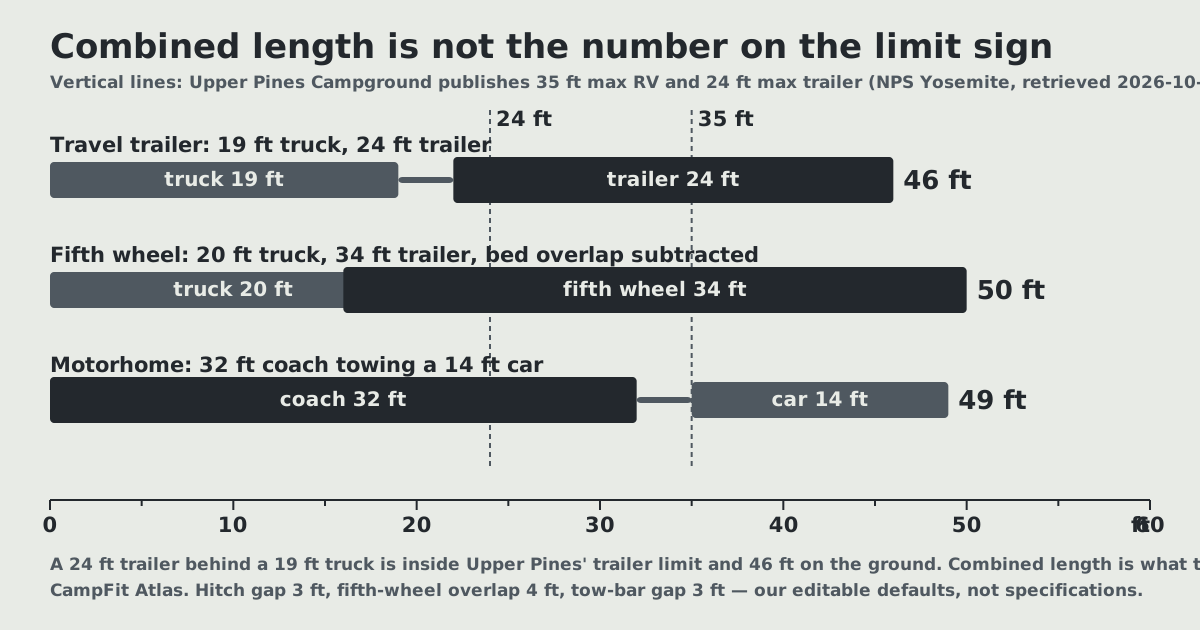
The RV trailer combined length campsite question is the only length question that matters once you are on the loop road, and it is not a number any manufacturer prints on a brochure. It is your tow vehicle, plus the gap at the hitch, plus the trailer, measured as the whole thing sits when it rolls. Campgrounds, meanwhile, mostly publish single-unit limits. This guide closes that gap.
Why one number is not enough
A campground limit describes equipment. Your arrival describes a train of equipment. Yosemite's Upper Pines publishes a 35-foot maximum RV length and a 24-foot maximum trailer length, across 236 sites at 4,000 feet, open all year (NPS Yosemite campgrounds, page last updated September 28, 2026). Both of those are measurements of one unit on its own. Neither one is the length of a truck and a trailer hitched together.
The hero diagram above draws the three common configurations to one scale against those two Upper Pines limits. A 19-foot truck with a 24-foot trailer is inside the 24-foot trailer limit and is 46 feet long on the ground. The limit and the reality are twenty-two feet apart, and both numbers are correct.
The arithmetic, by configuration
There are three shapes of rig and three slightly different sums. The fit calculator runs all three and draws the result; here is what it is doing.
Travel trailer, or any bumper-pull. Combined length is tow vehicle plus hitch gap plus trailer. The hitch gap is the distance from the tow vehicle's rear bumper to the front of the trailer with the coupler seated on the ball, and it is real space: with a weight-distribution hitch and a long tongue it can run past 3 feet. CampFit Atlas defaults to 3 feet and lets you set your own.
Fifth wheel. Combined length is truck plus trailer minus the overlap. The pin box sits over the bed, forward of the rear axle, so several feet of trailer are directly above several feet of truck. Those feet are not counted twice. The default overlap here is 4 feet. A 20-foot truck and a 34-foot fifth wheel are not 54 feet; they are 50.
Motorhome. Combined length is the coach plus, if you tow, the tow-bar gap plus the towed vehicle. A 32-foot coach with a 14-foot car behind an extended bar is 49 feet.
| Configuration | Formula | Worked example | Combined |
|---|---|---|---|
| Travel trailer | tow + hitch gap + trailer | 19 + 3 + 24 | 46 ft |
| Fifth wheel | truck + trailer − bed overlap | 20 + 34 − 4 | 50 ft |
| Motorhome, towing | coach + tow-bar gap + car | 32 + 3 + 14 | 49 ft |
| Motorhome, not towing | coach | 32 | 32 ft |
Note what the fifth-wheel row does to intuition. The fifth wheel in that table has by far the longest trailer — 34 feet against 24 and 14 — yet the whole rig comes out at 50 feet, one foot longer than the motorhome and its car. Hitched end to end it would be 54; the bed overlap buys back four feet. It also means a fifth wheel and a travel trailer of the same box length are different problems on the same spur.
Measure it, do not look it up
Published lengths are unreliable in a specific direction: they understate. Advertised and sometimes registered lengths are frequently box lengths — the living space — and they quietly omit the A-frame tongue, the propane rack, the spare tire carrier, the rear bumper, the bike rack and the ladder. Those add up to feet, not inches.
The measurement that matters takes ten minutes in a flat lot:
- Hitch up as you travel, with the weight-distribution bars on and the tow bar extended if you use one.
- Drop a mark at the frontmost point of the front vehicle. Bumper, not grille badge.
- Drop a mark at the rearmost point of the rear vehicle. Include the bumper, the carrier, the ladder, anything bolted on.
- Measure between the marks. That is your combined length.
- Measure the trailer alone the same way, front of coupler to rearmost point. That is the number you use when you unhitch.
- Write both on a card in the glovebox, in feet, rounded up.
Round up, never down. Rounding down is how people arrive confident and leave embarrassed.
The gap at the hitch is not a rounding error
People accept the trailer and the truck and then wave away the space between them, and it is the part of the sum most often wrong by the most feet.
On a bumper-pull, the gap runs from the tow vehicle's rear bumper to the trailer's foremost point with the coupler on the ball. A short receiver and a short A-frame can bring that under 2 feet. A weight-distribution hitch with spring bars, an extended shank for a tall truck, a bike rack on the receiver, or a long V-nose tongue can push it past 4. Three feet is a reasonable default and a poor substitute for measuring.
On a fifth wheel the gap is negative, and that is the whole point. The pin sits forward of the rear axle, so the trailer's nose is above the bed rather than behind it. How negative depends on where the pin is set and how long the bed is: a short-bed truck with the pin forward overlaps less than a long-bed with the pin back. Four feet is the default here. Get it wrong by two and you misstate your rig by two.
On a motorhome towing a car, the bar is the gap, and tow bars are longer deployed than stowed. Measure deployed.
None of these three gaps appears in any campground's published data, which is precisely why the calculator makes each one an editable field rather than a hidden constant. The arithmetic belongs to you; the site only publishes its ceiling.
Which published limit to compare against
Once you have a combined length, the job is matching it to the right kind of limit. There are three kinds in circulation, and treating them alike is the actual mistake behind most bad bookings.
A single-unit limit. Yosemite's "35 ft/24 ft" style entry, or Mather Campground's 30 feet for motorhomes or trailers. Grand Canyon's Mather page states that limit across 327 sites, with no hookups at all, and then names the five sites — 120, 121, 128, 172 and 185 — that fit a 30-foot trailer, noting other sites will not (Mather Campground). Compare your longest single unit to this, then separately satisfy yourself the spur holds the whole rig or that you can unhitch.
A combined limit. Fishing Bridge RV Park in Yellowstone states it accommodates RVs and tow vehicles up to 95 feet based on the availability of the right-size site, with 310 sites for hard-sided units only, full hookups for electricity, water and sewer at 50 or 30 amp, an Upper Loop of 172 paved sites ranging from 40 to 95 feet, and a Lower Loop of 30- to 35-foot gravel back-ins; reservations must include the combined length of the RV and any towed or other vehicles (Yellowstone National Park Lodges). This is the only kind of limit you can compare your combined number to directly.
A site-level equipment limit. Recreation.gov's individual campsite pages list permitted equipment with a maximum length for each type. Site 214 at Upper Pines permits an RV, pickup camper or camper van at 27 feet and a trailer or pop-up at 18 feet, is a paved back-in, and allows up to two vehicles. The page also states the rule behind that spread: the maximum trailer length is always shorter than the maximum RV length because of maneuverability. It further warns that if you arrive with different equipment than you booked you will likely not fit and will be turned away, which makes the equipment field part of the contract rather than a note.
The unhitching lever
The single biggest change available to a long rig is parking the tow vehicle somewhere other than the spur. If the trailer alone is 34 feet and the pair is 50, a 35-foot driveway goes from hopeless to workable the moment the truck moves.
Whether you may do that is a campground question. Site A024 at Watchman Campground in Zion lists a 39-foot driveway, a 39-foot maximum vehicle length, 30-amp electric, a water hookup of "No", a paved back-in entry, and an occupancy of two passenger vehicles, or one RV or camping trailer with its associated tow vehicle, or four motorcycles. That third phrasing is what permits the split. The facility page also states that generators are not allowed in the campground, that electric sites are all 30 amp with only a handful supplying 50, and that there are no full-hookup campsites (Watchman Campground).
The fit calculator has a checkbox for this case. Tick it and only the trailer is measured against the driveway; the verdict and the diagram both change.
Width, and why nothing judges it
Combined length has a companion number that almost no official page publishes: width. The calculator starts from 8.5 feet across the body and 3 feet per slide when extended — both our editable defaults rather than anyone's specification — so on those defaults a two-slide trailer occupies 14.5 feet of width while parked and far less while driving. Replace them with your own measurements.
CampFit Atlas reports that extended width and deliberately does not grade it. There is no authoritative site-width field to compare against on the pages this site uses, and inventing a threshold would be the sort of guess the whole project exists to avoid. What you get instead is the number, so you can look at the spur, the picnic table and the neighbour's awning and decide.
The one width constraint that does appear in official wording is incidental: Fishing Bridge describes some 30-foot Lower Loop sites as single-width, and Zion's approach-road restriction includes a 7-foot-10-inch width limit for the Zion-Mt. Carmel Highway from June 7, 2026. Width limits exist; they just rarely exist as a campsite field.
Worked examples against real published limits
Numbers in the abstract are easy to agree with and hard to use. Here are three rigs run against limits quoted from official pages, with the verdict the calculator gives at its default 5-foot margin.
A 19-foot truck with a 24-foot travel trailer, 46 feet combined. At Upper Pines the trailer is exactly at the published 24-foot trailer limit, so the campground will take it. The rig needs 51 feet of driveway to earn a "fits" verdict with margin, or 46 feet to merely sit there, and Upper Pines publishes no per-site driveway lengths on its facility page. Unhitched, the trailer alone needs 29 feet. The honest read: book it, plan to unhitch, and check the specific site page for its equipment line before you commit.
A 20-foot truck with a 34-foot fifth wheel, 50 feet combined. North Pines publishes 40 feet for an RV and 35 feet for a trailer across 81 sites, open approximately April 21 to October 26 (NPS Yosemite campgrounds). The 34-foot trailer is inside the 35-foot trailer limit by a foot. The 50-foot pair is not a number North Pines publishes anything about, so the whole question becomes whether a spur holds 50 feet or whether you may split the pair. At Fishing Bridge, by contrast, the same 50 feet is directly comparable to the stated figures: it is inside the 95-foot ceiling and inside the Upper Loop's 40-to-95-foot range, and outside the Lower Loop's 30-to-35-foot gravel back-ins.
A 32-foot motorhome towing a 14-foot car, 49 feet combined. Mather's 30-foot limit excludes the coach on its own, before the car is considered, so Mather is out. Trailer Village next door publishes paved pull-through sites accommodating vehicles up to 50 feet with full hookups of sewage, water and electrical in 30-amp and 50-amp options (NPS Trailer Village). Forty-nine feet against a 50-foot pull-through is a "tight" verdict, not a "fits" one: the arithmetic clears by a foot and the margin does not.
That last case is the one worth internalising. Two campgrounds a few minutes apart, one rig, and the answer flips entirely on the published number and the site geometry behind it.
Putting it together
Work in this order and the arithmetic stops being the hard part:
- Measure hitched. Write down both the combined length and the trailer-alone length.
- Identify what kind of limit the campground published: single unit, combined, or per-site equipment.
- Compare like with like, and if the limit is single-unit, check the spur separately.
- Decide in advance whether you will unhitch, because that is your fit lever.
- Add margin. Five feet is the default here; it is our assumption, labelled as one.
- Book the equipment you will actually show up with.
Every campground page on this site states which kind of limit the park published and quotes the sentence it came from, and the methodology lists every source with the date it was read. Get the RV trailer combined length campsite question answered before you book, and the loop road becomes somewhere you drive through rather than somewhere you reverse out of.
Frequently asked questions
How do I calculate my RV and trailer combined length?
Measure the tow vehicle bumper to bumper, measure the trailer including the tongue and the rear bumper, and add the hitch gap between them. For a fifth wheel, add truck and trailer and then subtract the overlap that sits over the truck bed, because that length is shared. For a motorhome towing a car, add the coach, the extended tow bar and the car.
Does a campground maximum RV length include the tow vehicle?
Only when the source says so. Yosemite's campground table publishes a maximum RV length and a separate maximum trailer length, each measured as one unit. Fishing Bridge RV Park in Yellowstone publishes a combined figure, up to 95 feet of RV plus tow vehicle, and asks for the combined length when you reserve. Same question, two different answers, so read the wording.
Is combined length the same as the length on my registration?
No. Registered or advertised lengths are often box lengths that exclude the tongue, the spare tire carrier, the rear bumper or a ladder. Measure the rig as it sits hitched in a parking lot, from the front bumper of the front vehicle to the rearmost point of the rear one, because that is the figure a campsite driveway has to hold.
Should I subtract the overlap on a fifth wheel?
Yes. A fifth-wheel pin sits forward of the truck's rear axle, so several feet of trailer occupy the same ground as the truck bed. CampFit Atlas uses a 4-foot overlap by default and lets you change it. Without that subtraction you will overstate your own length by roughly the depth of the bed.
Can I unhitch to make a long rig fit a short driveway?
Often, but not always. Where the campground allows the tow vehicle to park elsewhere on the site, only the trailer has to fit the driveway, which is the single largest change you can make to a fit verdict. Watchman site A024 in Zion, for example, is listed as holding two passenger vehicles, or one RV or camping trailer and its associated tow vehicle, which is the arrangement that lets the pair split up.
What margin should I add to combined length?
The fit calculator adds 5 feet by default so the rear door clears and the tow vehicle's nose stays off the loop road. That is an editorial assumption rather than a published standard, and it is editable, including down to zero if you want the bare arithmetic.