Going-to-the-Sun Road Vehicle Size Limit: 21 ft, 8 ft Wide
Going-to-the-Sun Road vehicle size limit: over 21 ft long or 8 ft wide is barred from Avalanche Creek to Rising Sun. What counts, and options for RVs.
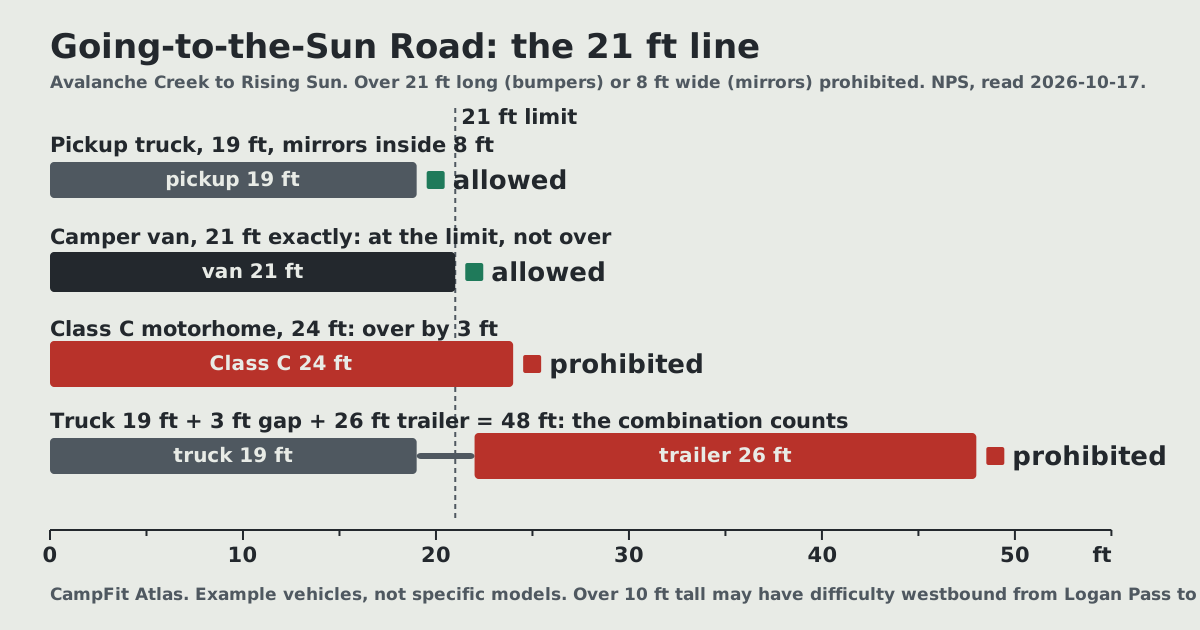
The Going-to-the-Sun Road vehicle size limit is 21 feet long and 8 feet wide: the National Park Service prohibits vehicles and vehicle combinations longer than 21 feet, including bumpers, or wider than 8 feet, including mirrors, between Avalanche Creek and Rising Sun. Most motorhomes and every travel trailer behind a full-size truck are over it, so RVers drive the road in a smaller vehicle, take a shuttle or tour, or drive around the park.
This guide covers the exact limits and where they apply, what counts in the measurement, how to run your own rig against them, and what an over-limit rig can still do in Glacier. The official pages cited were read on October 17, 2026.
The Going-to-the-Sun Road vehicle size limit, in numbers
These figures are from the National Park Service's Going-to-the-Sun Road information page, with the same limits repeated on the park's directions page and in its June 2026 news release on the road opening.
| Limit | Figure | What counts | Status |
|---|---|---|---|
| Length | 21 ft (6.4 m) | Vehicle or vehicle combination, including bumpers | Prohibited if longer, Avalanche Creek to Rising Sun |
| Width | 8 ft (2.4 m) | Including mirrors | Prohibited if wider, same section |
| Height | 10 ft (3 m) | Highest point of the vehicle | Caution, not a ban: may have difficulty westbound from Logan Pass to the Loop |
Two things in that table are easy to miss.
Combinations count as one. The park's wording is "vehicles and vehicle combinations", so a truck towing anything is measured nose to tail, not truck alone.
Height is a warning, not a prohibition. The park says vehicles over 10 feet tall "may have difficulty" westbound between Logan Pass and the Loop because of rock overhangs. It does not ban them. Taller rigs are almost always over the length limit anyway.
Where the restriction applies
The park names the restricted section as Avalanche Creek to Rising Sun. Recreation.gov's pages for Apgar Campground and Fish Creek Campground describe it as between the Sun Point parking area and Avalanche Campground. Either description puts the climb to Logan Pass, the pass itself and the descent on the east side inside the limit.
The stretches outside it are the lower ends of the road: from West Glacier along Lake McDonald up to Avalanche on the west side, and from St. Mary to Rising Sun on the east side. A big rig can reach Apgar and Fish Creek, and drive along Lake McDonald, without entering the restricted section.
The park also notes that stock trucks and trailers can access Packers Roost from the west and Siyeh Bend from the east, which are trailheads used by horse and stock parties.
What counts in the measurement
The park measures length "including bumpers" and width "including mirrors". In practice, that means:
- Length runs from the frontmost point to the rearmost point. A rear bike rack, cargo carrier, ladder or spare-tire carrier counts. For a combination, it runs from the front of the tow vehicle to the back of the trailer or towed car.
- Width runs across the mirrors as you drive with them. Towing mirrors stick out further than stock mirrors, so measure a pickup across its towing mirrors before assuming it is under 8 feet.
- Height, for the overhang warning, runs to the highest roof item: air conditioner, antenna, rack or cargo box.
Our guide on how to measure RV length walks through each tape measurement and where it starts and stops.
Run your rig against the limits
Here is the arithmetic for four illustrative vehicles, the same four drawn at the top of this page. They are example sizes, not specific models.
| Example vehicle | Length test (21 ft) | Width test (8 ft with mirrors) | Result |
|---|---|---|---|
| Pickup truck, 19 ft | 19 ft, inside | Measure across mirrors | Allowed if width passes |
| Camper van, 21 ft exactly | At the limit, not over | Measure across mirrors | Allowed if width passes |
| Class C motorhome, 24 ft | 3 ft over | Not needed | Prohibited |
| Pickup 19 ft + 3 ft hitch gap + 26 ft trailer | 48 ft, 27 ft over | Not needed | Prohibited |
The 3-foot hitch gap is this site's editable default; your own tape measure is better. The fit calculator adds up a combination for you and draws it to scale.
The table shows how tight 21 feet is. Even the example pickup has only 2 feet to spare, and the example motorhome is over. The road is effectively for cars, vans, smaller pickups and shuttle vehicles.
Why a rig that fits a campground can still be over the road limit
Every campground limit this site has verified is longer than 21 feet. The shortest is White Wolf in Yosemite, at 27 feet for an RV and 24 feet for a trailer. The longest is Fishing Bridge RV Park in Yellowstone, which accommodates RVs and tow vehicles up to 95 feet combined. Trailer Village at Grand Canyon takes vehicles up to 50 feet on its pull-through sites.
So a rig that fits comfortably in a national park campground can still be several times too long for the Sun Road. The two limits answer different questions. A campground limit asks whether your rig can be parked and turned on a loop. A road limit asks whether it can hold its lane on narrow, winding mountain grades.
| Rig | Fits a 27 ft campground limit? | Fits the 21 ft road limit? |
|---|---|---|
| 24 ft Class C motorhome | Yes | No |
| 19 ft pickup alone | Yes | Yes, if mirrors are within 8 ft |
| 19 ft pickup + 3 ft gap + 26 ft trailer | Trailer is outside a 24 ft trailer limit | No |
The practical upshot: check road limits separately from campground limits. The campground pages on this site cover the campground side; the park's road pages cover the other.
Compared with Zion's tunnel road
Glacier is not the only park with a road limit stricter than its campgrounds. Zion bars vehicles over 35 feet 9 inches long, or combinations over 50 feet, from the Zion-Mt. Carmel Highway between Canyon Junction and the East Entrance, under rules in force since June 7, 2026 (NPS Zion Large Vehicles).
| Going-to-the-Sun Road (Glacier) | Zion-Mt. Carmel Highway (Zion) | |
|---|---|---|
| Single vehicle length | 21 ft, including bumpers | 35 ft 9 in |
| Combination length | 21 ft total | 50 ft total; trailer max 26 ft hitch to rear axle |
| Width | 8 ft, including mirrors | 7 ft 10 in, including mirrors |
| Height | Over 10 ft: caution westbound, Logan Pass to the Loop | 11 ft 4 in limit |
| Section | Avalanche Creek to Rising Sun | Canyon Junction to East Entrance |
Zion's limit lets most motorhomes and many truck-and-trailer rigs through. Glacier's does not. Our Zion tunnel RV size limit guide covers the Zion rules in full.
Where an over-limit RV can still go in Glacier
Being over the limit closes the middle of one road, not the park.
Camp on either side. Apgar Campground, on the west side, has 194 campsites and five group sites, all listed as Standard Nonelectric, with potable water and flush toilets, according to its Recreation.gov page. Fish Creek, also on the west side, has 178 campsites, all nonelectric. Neither page publishes a campground-wide maximum RV length; the only length figure on either is the road restriction. Read the individual site pages for driveway and equipment lengths before booking. Apgar's page also says the campground switches to primitive status without water from September 30, 2026, with only Loop B open.
Drive around the park. The park's directions page gives West Glacier to St. Mary as 50 miles and 2 hours on Going-to-the-Sun Road, or 90 miles and 2 hours by US Highway 2 to Highway 89. Times vary with construction, traffic and time of day.
Take a shuttle or tour. The park's getting around page lists a fee-based, seasonal hiker's shuttle run by Glacier National Park Lodges, historic Red Bus tours, and Sun Tours, which runs 25-seat buses that the page describes as wheelchair accessible. The park's 2026 summer operations release says Logan Pass shuttles are ticketed through Recreation.gov with a $1 processing fee per ticket, that every passenger aged 2 and older needs one, and that the shuttle system began July 1, 2026.
Unhitch and drive the tow vehicle. A tow vehicle on its own is judged as a single vehicle. If it is 21 feet or less long including bumpers and 8 feet or less wide including mirrors, it can drive the road. Fold or swap towing mirrors if they push it over.
Generator rules at the west-side campgrounds
If you are basing a large RV at Apgar or Fish Creek, the generator rule is the next thing to check, because both are nonelectric campgrounds. Their Recreation.gov pages set the same windows: generators are allowed from 8 to 10 a.m., noon to 2 p.m., and 5 to 7 p.m. Apgar's page gives quiet hours from 10 p.m. to 6 a.m. Fish Creek does not allow generators in Loop C at all.
That is six generator hours a day outside Loop C, and none overnight. Our guide to national park generator rules compares those windows with Yosemite, Grand Canyon, Yellowstone, Zion and others.
Vehicle reservations and parking in 2026
Glacier's 2026 summer operations release says vehicle reservations will not be required anywhere in the park in 2026, though vehicles may be diverted temporarily when areas reach capacity.
The same release says that from July 1, weather permitting, private vehicles may park at Logan Pass for up to three hours, with no overnight parking except for permitted backcountry users and Granite Park Chalet guests. The getting-around page notes there are no fuel stations within the park's boundaries.
The road itself opens seasonally. The park says it typically opens between mid-June and early July and cannot predict an exact date. In 2026, the park announced on June 23 that the road was fully open for the season.
Planning a Glacier trip around the limit
A few decisions are easier to make at home than at Avalanche Creek.
Pick a side to base on. The restricted section separates the west side, with Apgar, Fish Creek and Lake McDonald, from the east side around St. Mary. With a large rig, moving between them means the 90-mile US Highway 2 route. Many RVers choose one side for the stay and see the other by shuttle, tour or a smaller vehicle.
Decide how you will see Logan Pass. If you are towing a car that is within 21 feet and 8 feet wide, the car is the simplest way up. If you are not, the ticketed shuttles and commercial tours are the alternatives, and the shuttle tickets are released on a schedule, so plan ahead.
Allow for fuel. With no fuel inside the park, fill up before you enter.
Common mistakes
Measuring the truck, not the combination. The limit names vehicle combinations. A short truck and a short trailer still add up.
Forgetting the mirrors. The 8-foot width limit includes them. Towing mirrors are the usual reason a vehicle within the length limit fails.
Assuming the whole road is closed to RVs. Only Avalanche Creek to Rising Sun is restricted. Lake McDonald and the St. Mary end are reachable in a large rig.
Relying on an old article for reservation rules. Glacier's reservation system has changed from year to year. The park's current release is the source.
Before you go
- Measure total length, including bumpers and anything on the back, and width across the mirrors.
- If either is over, plan to unhitch, take a shuttle or tour, or drive around via US Highway 2.
- Choose a campground on the side of the park you want to explore, and read its site pages for driveway lengths.
- Check road status close to your trip.
Measure with bumpers and mirrors included, compare the result with 21 feet and 8 feet, and you will know before you reach Avalanche Creek whether the Going-to-the-Sun Road vehicle size limit lets you through.
Sources
- National Park Service, Glacier: Going-to-the-Sun Road general information, last updated April 19, 2024; Directions, last updated May 7, 2026; Getting around, last updated May 7, 2026. All read October 17, 2026.
- National Park Service, Glacier: Going-to-the-Sun Road open for the 2026 season, June 23, 2026, and 2026 summer operations, read October 17, 2026.
- Recreation.gov: Apgar Campground and Fish Creek Campground, read October 17, 2026.
- National Park Service, Zion: Large Vehicles, last updated September 2, 2026, read October 17, 2026.
- Limits can change; the official page wins. Nothing here is a reservation or an availability claim.
Frequently asked questions
What is the Going-to-the-Sun Road vehicle size limit?
Vehicles and vehicle combinations longer than 21 feet, including bumpers, or wider than 8 feet, including mirrors, are prohibited between Avalanche Creek and Rising Sun, according to the National Park Service. The park also warns that vehicles over 10 feet tall may have difficulty driving west from Logan Pass to the Loop because of rock overhangs.
Can I drive a truck and trailer on Going-to-the-Sun Road?
Not over the restricted section unless the whole combination is 21 feet or less. The limit applies to vehicle combinations, so the truck, the hitch and the trailer count together. A pickup on its own uses much of that 21 feet, which leaves little or no room for a trailer. Unhitch at your campground and drive the truck alone if it is within 21 feet long and 8 feet wide with its mirrors.
Where does the RV restriction on Going-to-the-Sun Road start and end?
The National Park Service gives the restricted section as Avalanche Creek to Rising Sun. Recreation.gov's Apgar and Fish Creek campground pages describe the same restriction as between the Sun Point parking area and Avalanche Campground. Either way, the high middle of the road over Logan Pass is inside it, and the lower stretches near Lake McDonald on the west and St. Mary on the east are outside it.
How do I get from West Glacier to St. Mary in a big RV?
Go around the park. The National Park Service lists West Glacier to St. Mary as 50 miles and about 2 hours on Going-to-the-Sun Road, and 90 miles and about 2 hours by US Highway 2 to Highway 89. Times vary with construction, traffic and time of day.
Do I need a vehicle reservation for Going-to-the-Sun Road in 2026?
No. Glacier National Park's 2026 summer operations release says vehicle reservations will not be required anywhere in the park in 2026, though vehicles may be diverted temporarily when areas reach capacity. Logan Pass parking for private vehicles is limited to three hours from July 1, and the Logan Pass shuttles are ticketed through Recreation.gov.
Is a 21-foot camper van allowed on Going-to-the-Sun Road?
A vehicle of exactly 21 feet is at the limit, not over it, so it passes the length test if it is also no wider than 8 feet including mirrors. Measure your own van bumper to bumper, including any rear rack or spare-tire carrier, because those count toward length.