Zion Tunnel RV Size Limit 2026: Who Can Still Drive It
Zion's tunnel road now bars RVs over 35'9" alone or 50 ft combined, 7'10" wide or 11'4" tall. Check your rig and see where you can still go in Zion.
The Zion tunnel RV size limit now applies to the whole Zion-Mt. Carmel Highway: since June 7, 2026, a single vehicle over 35 feet 9 inches long, a combination over 50 feet, or anything over 7 feet 10 inches wide or 11 feet 4 inches tall cannot drive between Canyon Junction and the East Entrance. If your rig is over any one of those numbers, you can still enter Zion from the south and camp at Watchman, but you cannot cross the park to the east side.
That is the whole answer in two sentences. The rest of this guide covers the exact figures, what the park counts when it measures, how to run your own rig against them, and what an over-limit rig can still do in Zion.
The Zion tunnel RV size limit, in numbers
These are the National Park Service's limits, quoted from the park's Large Vehicles page, which was last updated September 2, 2026 and which we read on October 17, 2026. Exceed any single line and the park treats your rig as a "large vehicle."
| Limit | Single vehicle (motorhome, van, truck) | Combined vehicle (truck + trailer, motorhome + towed car) |
|---|---|---|
| Length | 35'-9" (10.9 m) | 50'-0" total (15.24 m) |
| Trailer | not applicable | No more than 26 ft (7.92 m) from hitch to rear axle |
| Width | 7'-10" (2.39 m) | 7'-10" (2.39 m) |
| Height | 11'-4" (3.45 m) | 11'-4" (3.45 m) |
| Weight | 50,000 lb (22,680 kg) | 50,000 lb (22,680 kg) |
The park defines a combined vehicle as two or more separate units physically connected at a pivot point and operating together, with a truck and trailer as its example. A motorhome flat-towing a car fits that definition too, so the 50-foot combined line is the one that applies to it.
The park is explicit that this is a road limit, "not just the Zion-Mt. Carmel Tunnel." It covers every mile from Canyon Junction, where the highway leaves the floor of Zion Canyon, up the switchbacks, through the tunnel and on to the East Entrance.
What counts in the measurement
The park measures more than the brochure length. Per the NPS page, measurements include mirrors, tires, and attachments such as AC units, bike racks, satellite dishes and other after-market modifications.
That changes three numbers for most RVers:
- Width. Side mirrors count. A rig whose body is narrower than 7 feet 10 inches can still be over once the mirrors are out, and towing mirrors on a pickup stick out further than the stock ones.
- Height. Measure to the top of the highest thing on the roof: the air conditioner shroud, an antenna, a satellite dish, a roof rack or a cargo box. The roofline is not the number.
- Length. Rear bike racks, cargo carriers, ladders that stand proud of the back wall and spare tire mounts all count, and so does the hitch.
For a combination there are two length tests, and you have to pass both: the whole rig at 50 feet or less, and the trailer at 26 feet or less from the hitch to its rear axle. That second number is not the trailer's advertised length. It runs from the coupler, or a fifth wheel's kingpin, back to the center of the rearmost axle, and the only reliable way to get it is a tape measure.
How to measure your rig for Zion
Do this once, write the numbers on a card in the cab, and you will never have to guess at an entrance station again.
- Total length, hitched. Park on level ground in a straight line. Run a tape from the front bumper of the lead vehicle to the furthest point at the back, including any rack or carrier. For a motorhome towing a car, include the tow bar and the car. Compare this to 50 feet if you are a combination, or 35 feet 9 inches if you are a single vehicle.
- Hitch to rear axle. For a trailer, measure from the center of the coupler or kingpin to the center of the rearmost axle hub. Compare to 26 feet.
- Width. With mirrors set where you drive with them, measure from the outside edge of one mirror to the outside edge of the other. If that is awkward, drop a plumb line or a level from each mirror tip to the ground, mark both spots, and measure between the marks. Compare to 7 feet 10 inches.
- Height. Stand a straight board or level on the highest roof item, hold it level out past the side of the rig, and measure from its underside to the ground. Compare to 11 feet 4 inches.
- Weight. The 50,000 lb limit exists because four bridges on the highway cannot carry more, according to the park. Your door-jamb label or your rig's documentation gives its rated weights; a certified scale gives its actual weight.
The fit calculator on this site adds up the combined length for you, including fifth-wheel bed overlap and the gap behind a towed car, and draws the result to scale. It does not know your mirrors or your roof gear, so width and height still need the tape.
Run your rig against the limits
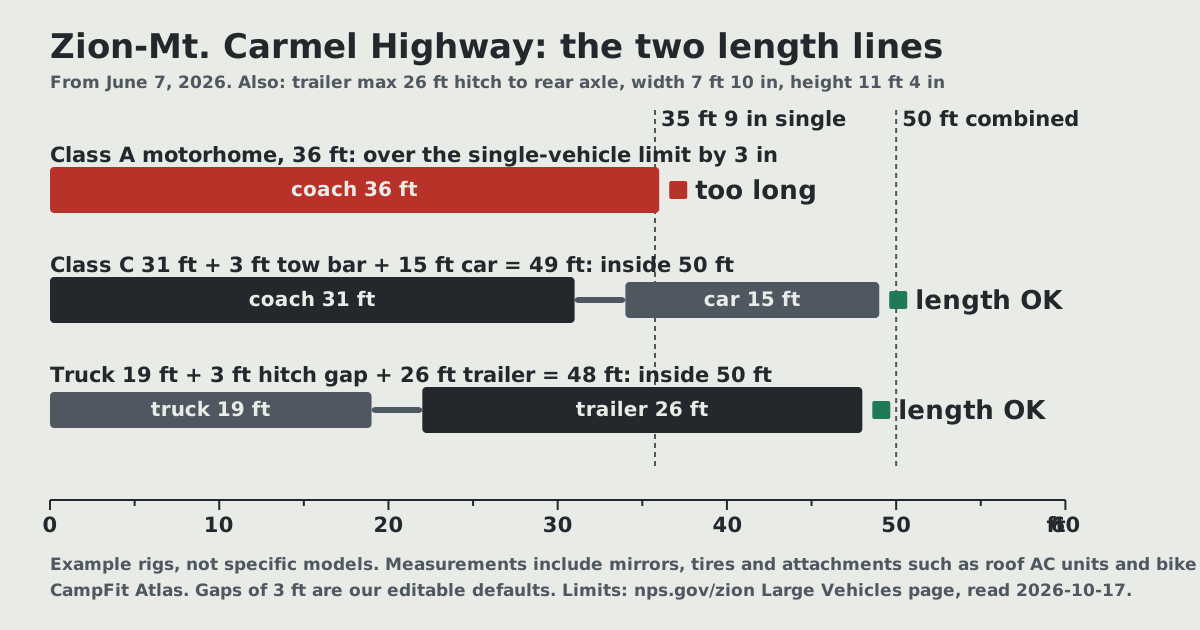
Here is the arithmetic for three made-up rigs, the same three drawn to scale at the top of this page. The numbers are illustrations, not specific models. The gaps behind the tow vehicle use this site's editable defaults of 3 feet; your own tape measure beats any default.
| Example rig | Length test | Other tests | Result |
|---|---|---|---|
| Class A motorhome, 36 ft bumper to bumper | 36'0" is over the 35'9" single-vehicle limit | Not needed | Not allowed |
| Class C 31 ft + 3 ft tow bar + 15 ft car | 31 + 3 + 15 = 49 ft, inside the 50'0" limit | The car is far under 26 ft from tow bar to rear axle; check width with mirrors and height to the roof AC | Allowed only if width and height also pass |
| Pickup 19 ft + 3 ft hitch gap + 26 ft trailer, 22 ft hitch to rear axle | 19 + 3 + 26 = 48 ft, inside the 50'0" limit | 22 ft passes the 26 ft hitch-to-axle test; measure tow-mirror width | Allowed only if width and height also pass |
The first row is the one that surprises people. A motorhome sold as a 36-footer misses by three inches, and three inches is enough. The park does not round.
The second and third rows show why length alone settles nothing. Both rigs clear 50 feet, and both can still be turned around for being too wide at the mirrors or too tall at the air conditioner. Run all five tests, not just the one on the brochure.
If you have never added up your full combination, our combined length guide walks through the arithmetic for each rig type.
What changed on June 7, 2026
Before June 7, 2026, large vehicles could drive the highway as long as rangers stopped oncoming traffic for them at the tunnel. The park's planning guide describes that older rule: until June 6, 2026, oversize vehicles could use the highway with traffic control through the tunnel, and driving a large vehicle through the tunnel without it was unlawful.
From June 7, 2026, vehicles over any limit are not permitted on the highway between Canyon Junction and the East Entrance at all. The current NPS Large Vehicles page lists no pass or escort that lets an over-limit vehicle through. Plenty of older RV articles still describe paying for a tunnel escort; that option does not appear on the current official page, and the page says over-limit vehicles arriving at either entrance will be given instructions for turning around.
The park gives three reasons, based on safety studies from 1989 and 2019 that the Federal Highway Administration validated:
- Vehicles longer than the limits cannot hold their lane on the highway's tight curves and switchbacks.
- Vehicles wider or taller than the limits cannot pass through the tunnel in a single lane.
- Vehicles over 50,000 lb exceed the weight limits on four bridges along the highway.
The park also points to delays under the old escort system: a 2016 study it cites found an average of 19 minutes of free-flowing traffic through the tunnel out of each hour, and only eight minutes on the busiest day.
Where an over-limit RV can still go in Zion
According to the NPS page, if your vehicle exceeds the limits you will be told how to turn around at the South or East Entrance, with these exceptions for drivers entering through the South Entrance:
- Parking in the large vehicle lot by the Zion Canyon Visitor Center, if there is room
- Visiting Zion Lodge with a valid reservation
- Driving the Zion Canyon Scenic Drive during the shuttle off-season
- Camping in Watchman Campground, or South Campground once it is open
So a big rig can still camp at Watchman and see Zion Canyon. What it cannot do is drive the highway east through the tunnel. If your trip continues east toward Mt. Carmel Junction and the parks beyond, plan the detour before you arrive rather than at the gate.
Watchman Campground for big rigs
Watchman is where most RVers who cannot use the highway will end up, so here is what its official pages state, read from the Recreation.gov facility page on October 16, 2026.
- No campground-wide maximum RV length. The official pages do not publish one. That is why this site has no Watchman fit page yet: a single site's figure is not a campground limit, and we will not invent one.
- Some loops are effectively small-rig only. The tent-only F loop and the non-electric C and D loop sites do not permit vehicles 19 feet and over, including 19 feet and over in combined length.
- Electric sites are in the A and B loops. They may be used for tent or RV camping. Electric sites are 30 amp, with a handful that supply 50 amp, and there are no full-hookup campsites.
- A dump station with potable water is at the entrance to the campground.
- Generators are not allowed in the campground.
- Reservations open six months in advance.
For a sense of site scale, Recreation.gov lists site A024 with a 39-foot maximum vehicle length and a 39-foot paved back-in driveway, permitting an RV, trailer, fifth wheel or camper van at 39 feet. That is one site, not a promise about the rest of the loop, so open the specific site page you want and read its driveway length and permitted-equipment line before you book. Our driveway length vs RV length guide explains how to read those fields.
If you are over the limit
You have three practical options:
- Go around. The NPS lists the shortest alternative routes at the bottom of its Large Vehicles page. Check them before you set your route, because a detour decided at the entrance station is a detour driven tired.
- Unhitch and drive the tow vehicle. A truck or car on its own is judged as a single vehicle. If it is no more than 35 feet 9 inches long, 7 feet 10 inches wide with its mirrors, and 11 feet 4 inches tall, it can drive the highway. Leave the trailer or motorhome at your campground first. Wide towing mirrors are the usual catch, so measure them or fold them back to the stock position before you go.
- Base outside the park. Stay at a campground that fits your rig and drive in with a smaller vehicle.
If Zion is one stop on a longer park trip, our guide to 35-foot RV national park campsites covers how to filter campgrounds by length on Recreation.gov.
Common measuring mistakes
These are the ways a rig that "should" pass ends up turned around.
Using the model number as the length. RV model names are marketing. A floorplan called "33" can be longer than 33 feet bumper to bumper once the hitch and rear bumper are counted. Measure.
Forgetting what is on the back. A bike rack or cargo carrier on the rear adds length. It counts toward length under the NPS rules, and on a rig that is close to 35 feet 9 inches, it decides the answer.
Measuring height to the roof, not the AC. The roof air conditioner, antenna or satellite dish usually sits well above the roofline, and the park counts it.
Measuring width without mirrors. The body width on a spec sheet excludes mirrors. The park's measurement includes them.
Assuming the trailer's length is its hitch-to-axle number. The 26-foot test is measured to the rear axle, not the rear bumper, and it applies on top of the 50-foot total. A trailer can pass one and fail the other.
Before you go
- Measure total length, hitch to rear axle, width with mirrors, and height to the highest roof item.
- Compare each one to the table above. Any single miss means no highway.
- If you are over, decide in advance whether you will detour, unhitch or base outside the park.
- Book Watchman site by site, reading each site's driveway and permitted-equipment lengths.
- Recheck the NPS Large Vehicles page close to your trip, because the official page wins over this one.
Measure your rig with mirrors and roof gear included, compare every number in the table, and you will know before you reach the gate whether the Zion tunnel RV size limit lets you through.
Sources
- National Park Service, Zion: Large Vehicles, last updated September 2, 2026, read October 17, 2026.
- National Park Service, Zion: Planning Guide, read October 17, 2026.
- National Park Service, Zion: news release on large vehicle restrictions, January 5, 2026.
- Recreation.gov: Watchman Campground and site A024, read October 16, 2026.
- Limits can change; the official page wins. Nothing here is a reservation or an availability claim.
Frequently asked questions
What is the Zion tunnel RV size limit?
A single vehicle can be no more than 35 feet 9 inches long, 7 feet 10 inches wide, 11 feet 4 inches tall and 50,000 lb. A combination such as a truck and trailer can be no more than 50 feet in total, with the trailer no more than 26 feet from hitch to rear axle, and the same width, height and weight limits. The National Park Service says measurements include mirrors, tires and attachments.
Can I pay for an escort through the Zion tunnel?
Not if your vehicle exceeds the limits. Since June 7, 2026, vehicles over any limit are not permitted on the Zion-Mt. Carmel Highway between Canyon Junction and the East Entrance, and the current National Park Service Large Vehicles page lists no escort or pass for them.
Does the limit apply only to the tunnel?
No. The National Park Service says the restrictions cover the entire section of highway between Canyon Junction and the East Entrance, not just the Zion-Mt. Carmel Tunnel.
Can I still camp at Watchman Campground with a big RV?
Yes. The National Park Service lists camping at Watchman Campground, and South Campground once it is open, as an exception for over-limit vehicles entering through the South Entrance. Watchman publishes no campground-wide maximum RV length, so check the individual site's driveway and equipment lengths on Recreation.gov before booking.
Do mirrors count toward the 7 foot 10 inch width limit?
Yes. The National Park Service says measurements include mirrors, tires, and attachments such as AC units, bike racks and satellite dishes, so measure with your mirrors in the position you drive with.
Is a 50-foot truck and trailer allowed?
A combination of exactly 50 feet is at the limit, not over it, so the length test passes, as long as the trailer is 26 feet or less from hitch to rear axle and the rig is within the width, height and weight limits.