How to Measure RV Length for Campsites and Park Roads
How to measure RV length: where to start and stop on a travel trailer, fifth wheel and motorhome, and which number each campground or road limit wants.
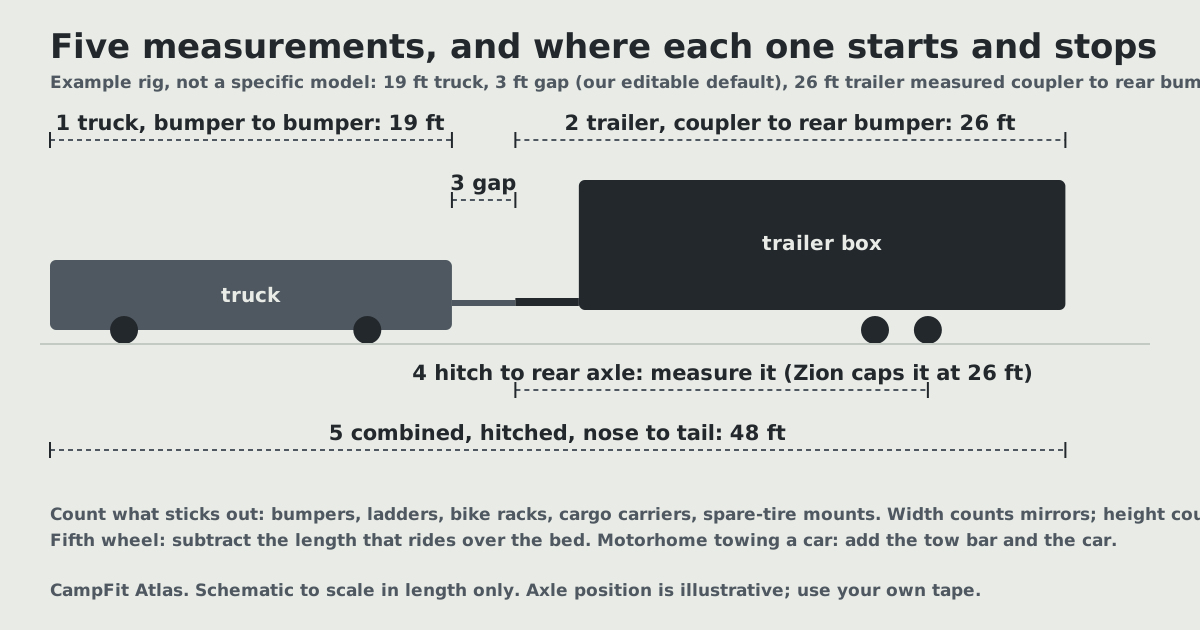
How to measure RV length comes down to one rule: measure the rig the way the limit you are checking measures it, from its frontmost point to its rearmost point, with everything that sticks out included. A campground's trailer limit, a campsite's driveway, and a park road's combined-vehicle limit each want a different number, so you need four or five measurements, not one.
This guide shows where each measurement starts and stops for a travel trailer, a fifth wheel and a motorhome, which limit each number is compared against, and the mistakes that make a brochure length unreliable. It uses manufacturer and National Park Service definitions read on October 17, 2026.
The five measurements, and why you need all of them
| # | Measurement | From | To | Compared against |
|---|---|---|---|---|
| 1 | Tow vehicle or motorhome | Front bumper | Rear bumper, or hitch if it sticks out further | Max RV length (motorhome); road single-vehicle limits |
| 2 | Trailer or towed car | Coupler, kingpin or front bumper | Rear bumper or furthest rear attachment | Max trailer length on campground and site pages |
| 3 | Gap | Rear of the lead vehicle | Front of the towed unit | Part of the combined length |
| 4 | Hitch to rear axle | Center of the coupler or kingpin | Center of the trailer's rearmost axle | Zion's 26-foot trailer limit and similar road rules |
| 5 | Combined, hitched | Front of the lead vehicle | Rearmost point of the towed unit | Max combined length; driveway length; road combination limits |
The figure at the top of the page marks each one on an example 19-foot truck and 26-foot trailer. Those are illustration figures, not a specific model. The 3-foot gap is the calculator's editable default.
Measurement 5 is the one people skip and the one most likely to matter. Our combined length guide explains why a campground's single-unit limits and your hitched length are different questions.
How to measure RV length on level ground
Do this once in a flat lot, write the numbers on a card in the cab, and you will not have to guess at a reservation screen.
- Park straight and hitched, on level ground. A rig parked at an angle measures shorter in a straight line than it really is.
- Find the true front and rear. The front is the bumper, grille guard or front-mounted carrier, whichever sticks out furthest. The rear is the bumper, ladder, spare tire, bike rack or cargo carrier, whichever sticks out furthest.
- Drop plumb points to the ground. Hang a weighted string, or hold a level vertically, at the front and rear points and mark the ground. Measure between the marks. This avoids bending the tape around a bumper.
- Measure each unit the same way. For a trailer, the front point is the coupler or the front of the tongue, not the front wall.
- Measure hitch to rear axle. From the center of the coupler, or a fifth wheel's kingpin, to the center of the rearmost axle hub.
- Write down width and height. Width with mirrors in their driving position. Height to the top of the highest roof item.
The National Park Service is explicit about what counts. On Zion's Large Vehicles page, it says measurements include mirrors, tires, and attachments such as AC units, bike racks, satellite dishes or other after-market modifications. Most campground pages are less specific, but measuring the same way means your number is never short.
Travel trailers: start at the coupler
The most common mistake with a travel trailer is measuring the box and forgetting the tongue.
Airstream states the convention plainly: all Airstream travel trailer exterior lengths are measured from the center of the hitch to the end of the rear bumper, and trailers without bumpers are measured to their furthest exterior rear points (Airstream support). The tongue and coupler are part of the trailer's length.
That matters because campground trailer limits are typically lower than RV limits. Yosemite's campground table, as recorded on this site, lists Upper Pines at 35 feet for an RV and 24 feet for a trailer. A trailer whose box is 21 feet and whose tongue adds a few more can be over 24 feet once measured from the coupler. Recreation.gov's site pages state the reason the trailer figure is lower: the maximum allowable trailer length is always shorter than the allowable RV length, due to maneuverability (Upper Pines site 214).
For the gap between truck and trailer, measure from the truck's rear bumper to the trailer's coupler with the trailer hitched. A weight-distributing hitch or a long ball mount adds to it.
Fifth wheels: measure hitched, because the overlap is shared
A fifth wheel's front section rides over the truck bed, so the truck and trailer lengths overlap. Adding them double-counts the overlap.
Measure three things:
- The fifth wheel alone, from the front of the cap or pin box, whichever is further forward, to the rear bumper or furthest rear attachment. This is the number for a campground's trailer limit.
- The truck alone, bumper to bumper.
- The rig hitched, from the truck's front bumper to the fifth wheel's rear. This is your combined length.
The difference between truck plus trailer and the hitched figure is the overlap. The fit calculator subtracts a default overlap of 4 feet. That default is our editorial assumption, not a specification, and it varies with the truck's bed length and where the hitch sits. Replace it with your own measurement.
Measure kingpin to rear axle too. Zion's road limit, for example, caps a trailer at 26 feet from hitch to rear axle on top of its 50-foot combined limit. That is a different figure from the fifth wheel's overall length.
Fifth wheels also have a measurement that is not a length: the clearance between the front corners of the trailer and the truck cab in a tight turn. Andersen Hitches, a hitch manufacturer, says the turning limit is "where the nose or sidewalls of your trailer will hit your cab," and suggests measuring from the center of the kingpin to the trailer's nose and sidewalls to check (Andersen Hitches). That matters when backing into a campsite.
Motorhomes: the coach, then the car
A motorhome on its own is one measurement: front bumper to rear bumper, plus anything mounted behind, such as a ladder, a bike rack or the receiver for a tow bar.
If you flat-tow or dolly-tow a car, add:
- The tow bar or dolly, from the motorhome's rear bumper to the car's front bumper. The calculator uses a 3-foot default, which is our editable assumption.
- The car, bumper to bumper.
Compare the coach alone to a campground's maximum RV length, the car to a maximum trailer length if one is published, and the total to any combined limit and to the driveway. Many motorhome drivers unhitch the car at the campground, which turns the driveway question back into the coach alone.
Which number each limit wants
The table below shows how different published limits read different measurements. The figures come from the official pages named, as recorded on this site's campground pages or read on October 17, 2026.
| Limit | Example | Measurement it reads |
|---|---|---|
| Maximum RV length | Upper Pines: 35 ft | 1: the motorhome alone |
| Maximum trailer length | Upper Pines: 24 ft | 2: the trailer, coupler to rear |
| Maximum combined length | Fishing Bridge RV Park: up to 95 ft, RV plus tow vehicle | 5: the whole rig hitched |
| Road single-vehicle limit | Zion-Mt. Carmel Highway: 35 ft 9 in | 1: one vehicle, mirrors and attachments included |
| Road combination limit | Zion-Mt. Carmel Highway: 50 ft total | 5: the whole rig hitched |
| Road trailer axle limit | Zion-Mt. Carmel Highway: 26 ft hitch to rear axle | 4: coupler or kingpin to rearmost axle |
| Road length including combinations | Going-to-the-Sun Road: 21 ft including bumpers | 5 for a combination, or 1 for a single vehicle |
| Campsite driveway length | Watchman site A024: 39 | 5 if you stay hitched; 2 if you unhitch |
Fishing Bridge's concessioner asks, when you reserve, for the combined length of your RV and any other vehicles or towed vehicles (Yellowstone National Park Lodges). That is measurement 5 by name.
Worked example: one trailer, two tape readings, different answers
Here is why the starting point matters, using the trailer limits this site has verified. Take an illustrative travel trailer whose box, measured front wall to rear bumper, reads 23 feet, and which measures 26 feet from the coupler to the rear bumper. These are example figures, not a specific model.
| Trailer limit (from this site's records) | Campgrounds | Box reading, 23 ft | Coupler reading, 26 ft |
|---|---|---|---|
| 24 ft | Upper Pines, Bridalveil Creek, Tuolumne Meadows, White Wolf | Inside | Outside |
| 30 ft | Mather, Hodgdon Meadow | Inside | Inside |
| 35 ft | North Pines, Lower Pines, Wawona, Crane Flat | Inside | Inside |
Measured the wrong way, the trailer looks fine for all ten. Measured from the coupler, the way manufacturers like Airstream measure and the way a trailer limit is applied, it is outside four of them. That four-campground gap is three feet of tongue. Mather adds a further catch: its Recreation.gov page names only five sites that fit a 30-foot trailer, so being inside its campground limit is not the same as fitting most of its sites.
The fit calculator reaches the same verdicts with its default demo rig of a 19-foot truck and a 26-foot trailer, and lists every verified campground with the figure that decides.
Width and height, while the tape is out
Length is the number campgrounds publish most, but roads and tunnels limit width and height too.
Width. Measure across the mirrors as you drive with them. Glacier's Going-to-the-Sun Road prohibits vehicles wider than 8 feet including mirrors between Avalanche Creek and Rising Sun (NPS Glacier). Zion's highway limit is 7 feet 10 inches, also including mirrors. Towing mirrors on a pickup stick out further than stock ones.
Slide-outs. Measure the width with slides extended too. The calculator starts at 8.5 feet for the body and 3 feet per slide, both editable defaults. Campsite pages rarely publish a usable width, so this is mostly for knowing what to look for on a campground map.
Height. Stand a straight board on the highest roof item, hold it level past the side of the rig, and measure down to the ground. Zion's highway limit is 11 feet 4 inches, and Glacier warns that vehicles over 10 feet tall may have difficulty driving west from Logan Pass to the Loop because of rock overhangs.
Why the brochure number is not enough
Model names are marketing. Airstream says most of its floor plan names include the trailer's length but that the names alone do not give exact figures, and directs owners to each floor plan's specification page. Other makers name floor plans their own way. The name is a hint, not a measurement.
Spec sheets leave things off. A spec sheet describes the trailer as built. It does not know about your bike rack, cargo box, tow bar or the longer ball mount you fitted.
The hitched length is not on any spec sheet. It depends on your truck and your hitch. Only a tape finds it.
A card for the cab
Write these on one card and keep it with the registration:
- Tow vehicle or coach, bumper to bumper
- Trailer or towed car, coupler to rear
- Gap at the hitch or tow bar
- Combined length, hitched
- Coupler or kingpin to rear axle
- Width across mirrors, and with slides out
- Height to the highest roof item
Enter the first four into the calculator, and it will check them against every campground on this site that publishes a verified limit. The campground pages quote each limit and its source.
Measure once, hitched and on level ground, include everything that sticks out, and you will know how to measure RV length for any campground or road limit you meet.
Sources
- Airstream: How is the travel trailer exterior length measured?, read October 17, 2026.
- Andersen Hitches: 5th wheel hitch and short bed trucks turn radius, read October 17, 2026.
- National Park Service, Zion: Large Vehicles, last updated September 2, 2026, read October 17, 2026.
- National Park Service, Glacier: Going-to-the-Sun Road general information, read October 17, 2026.
- Recreation.gov: Upper Pines site 214, read October 17, 2026.
- Yellowstone National Park Lodges (authorized concessioner): Fishing Bridge RV Park, read October 17, 2026.
- Limits can change; the official page wins. Nothing here is a reservation or an availability claim.
Frequently asked questions
How do you measure the length of an RV?
On level ground, run a tape from the frontmost point to the rearmost point, including bumpers and anything bolted on such as a ladder, bike rack, cargo carrier or spare-tire mount. For a trailer, start at the coupler, not the front wall of the box. For a whole rig, measure hitched, from the front bumper of the lead vehicle to the rearmost point of the last one.
Does RV length include the hitch?
For a travel trailer, manufacturers usually include it. Airstream, for example, says all of its travel trailer exterior lengths are measured from the center of the hitch to the end of the rear bumper. A campground's trailer limit is usually read the same way, so measure from the coupler.
Is the number in my RV's model name its length?
Not reliably. Airstream says most of its floor plan names include the trailer's length but that the name alone does not give exact figures, and points owners to each floor plan's specification page. Use the spec sheet's exterior length, or better, your own tape.
How do I measure a fifth wheel for a campsite?
Measure the fifth wheel from the front of the pin box or cap to the rear bumper, measure the truck bumper to bumper, then measure the whole rig hitched. The hitched figure is shorter than the two added together because the front of the fifth wheel rides over the truck bed. The fit calculator subtracts a default 4-foot overlap, which is an editable assumption; your own hitched measurement replaces it.
Do mirrors count toward RV width?
For road limits, often yes. The National Park Service says its Zion-Mt. Carmel Highway limits include mirrors, tires and attachments such as AC units, bike racks and satellite dishes, and Glacier's Going-to-the-Sun Road width limit of 8 feet includes mirrors. Campsite pages usually publish no width limit for the rig at all.