National Park Generator Rules: Hours by Campground
National park generator rules vary by park and loop: hours at Yosemite, Grand Canyon, Glacier, Yellowstone and Joshua Tree, plus the 60 dB federal limit.
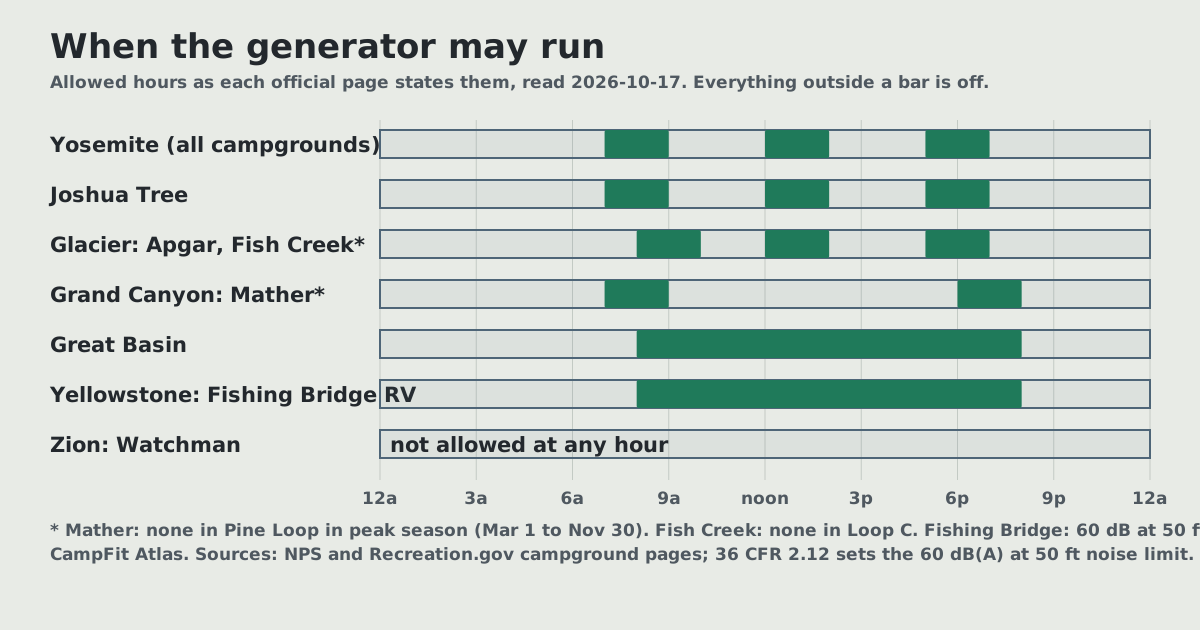
National park generator rules are set park by park and often loop by loop, so there is no single schedule to memorize: Yosemite allows generators for three two-hour windows a day, Grand Canyon's Mather Campground for two, Yellowstone's Fishing Bridge RV Park and Great Basin from 8 a.m. to 8 p.m., and Zion's Watchman Campground not at all. Over all of them sits one federal noise rule, 60 decibels at 50 feet.
This guide lists the published hours for the campgrounds covered on this site and a few more, explains the federal limit, and shows where to find the rule for a campground not listed here. Every schedule was read from an official page on October 17, 2026.
Why generator rules matter more in national parks
Most national park campgrounds have no hookups. Of the twelve campgrounds this site has verified, ten publish no electric, water or sewer at the site, and Yosemite states that no campsites in the park have hook-ups of any kind. Our campground hookups guide walks through that finding campground by campground.
Without a pedestal, the generator is how a lot of RVers run the microwave, top up batteries or cool the rig. That makes the allowed hours a real planning input, not small print. A rig that needs its air conditioner through a desert afternoon will have a very different trip in a park that allows generators from 8 a.m. to 8 p.m. than in one that allows two hours at midday.
National park generator rules, campground by campground
These are the allowed hours as each official page states them. The figure at the top of the page draws the same schedules on a 24-hour clock.
| Park and campground | Generators allowed | Exceptions and limits | Source |
|---|---|---|---|
| Yosemite, all campgrounds | 7–9 a.m., noon–2 p.m., 5–7 p.m. | Not allowed at other times; quiet hours 10 p.m.–6 a.m. | NPS Yosemite camping regulations |
| Grand Canyon, Mather | 7–9 a.m., 6–8 p.m. | None in Pine Loop (sites 265–319) during peak season; quiet hours 10 p.m.–6 a.m. | Recreation.gov, Mather |
| Yellowstone, Fishing Bridge RV Park | 8 a.m.–8 p.m. | Must not exceed 60 decibels at 50 feet; quiet hours 10 p.m.–6 a.m. | Yellowstone National Park Lodges |
| Zion, Watchman | Not allowed | Campground-wide | Recreation.gov, Watchman |
| Glacier, Apgar | 8–10 a.m., noon–2 p.m., 5–7 p.m. | Quiet hours 10 p.m.–6 a.m. | Recreation.gov, Apgar |
| Glacier, Fish Creek | 8–10 a.m., noon–2 p.m., 5–7 p.m. | Not allowed in Loop C | Recreation.gov, Fish Creek |
| Joshua Tree, all campgrounds | 7–9 a.m., noon–2 p.m., 5–7 p.m. | Quiet hours begin at 10 p.m. | NPS Joshua Tree camping regulations |
| Great Basin | 8 a.m.–8 p.m. | No more than one RV per campsite | NPS Great Basin camping regulations |
Three things stand out once they are side by side.
The window pattern is common but not uniform. Yosemite and Joshua Tree use the same three windows. Glacier's two campgrounds above shift the morning window an hour later, to 8–10 a.m. Mather drops the midday window entirely and moves the evening one to 6–8 p.m. A driver who learned the rule at one park will be an hour off at the next.
The long-day parks are the exception. Great Basin and Fishing Bridge allow 12 continuous hours. Fishing Bridge has full hookups at 50 or 30 amp, so few of its guests need a generator at all.
One campground bans them outright. Watchman, in Zion, does not allow generators in the campground, though its A and B loops have 30-amp electric sites, with a handful at 50 amp.
How many generator hours a day that adds up to
Adding up the windows gives a single number that is easier to compare than a list of times. This is plain arithmetic on the published schedules above, nothing more.
| Campground | Allowed windows | Generator hours per day |
|---|---|---|
| Fishing Bridge RV Park, Yellowstone | 8 a.m.–8 p.m. | 12 |
| Great Basin | 8 a.m.–8 p.m. | 12 |
| Yosemite, all campgrounds | Three two-hour windows | 6 |
| Joshua Tree | Three two-hour windows | 6 |
| Apgar and Fish Creek, Glacier | Three two-hour windows | 6 (none in Fish Creek Loop C) |
| Mather, Grand Canyon | Two two-hour windows | 4 (none in Pine Loop in peak season) |
| Watchman, Zion | None | 0 |
The spread runs from zero to twelve hours. A rig that needs eight hours of generator time a day fits only the first two rows, and a rig that can live on six fits most of the list. That one calculation narrows a park choice faster than any list of amenities, and it is the reason to look the rule up before you look at photos.
The federal rule behind every schedule
The Code of Federal Regulations sets a floor that applies in every park. Under 36 CFR 2.12, it is prohibited to operate motorized equipment or machinery, and the regulation names "an electric generating plant" among its examples, in a way that:
- exceeds a noise level of 60 decibels measured on the A-weighted scale at 50 feet, or
- makes noise that is unreasonable, considering the nature and purpose of the conduct, the location, the time of day or night, the purpose for which the area was established, and other factors.
That is why Fishing Bridge's page states a 60-decibel-at-50-feet cap: it is the federal number, restated. It is also why a campground's posted hours are not the whole rule. A generator running inside its window can still break 2.12 if it is loud enough, and a ranger can act on noise that is unreasonable even inside the allowed hours.
The regulation does not set quiet hours itself. Those come from each park's own rules, which is why Yosemite, Mather and Fishing Bridge all post 10 p.m. to 6 a.m. separately.
Generator-free loops
Some campgrounds allow generators in most loops and ban them in one. If you are sensitive to noise, these are the loops to book. If you depend on a generator, these are the loops to avoid.
Mather Campground, Pine Loop. Recreation.gov lists Pine Loop as sites 265 to 319. During peak season, March 1 to November 30, generators are not permitted there. In winter, Pine Loop follows the same generator hours as the rest of the campground. The Mather campground page on this site carries that rule with the rest of Mather's published details.
Fish Creek Campground, Loop C. Glacier's Fish Creek bans generators in Loop C and allows them in its three windows elsewhere.
When a campground has a generator-free loop, the loop name on the site page is the thing to check before booking. A site number alone does not tell you which side of the rule it is on.
Planning around the hours
A schedule of two-hour windows changes how a no-hookup stay works. A few practical consequences follow straight from the numbers in the table.
Charge in the first window. In Yosemite, Joshua Tree, Apgar and Fish Creek, the first chance to run a generator is 7 or 8 a.m. and the next is noon. Anything that needs a long charge should start in the morning window.
Cooling is the hard case. A rig that relies on a roof air conditioner will not have it from a generator through a mid-afternoon in any of the window-style campgrounds. Mather's schedule has no midday window at all. If heat is the concern, a campground with hookups or a long generator day matters more than the campground's scenery.
Evening ends early. Mather's last window closes at 8 p.m.; Yosemite's, Joshua Tree's and Glacier's at 7 p.m. Quiet hours then run from 10 p.m. Plan cooking and battery top-ups to finish inside those windows.
Zero means zero. At Watchman, a rig without an electric site has battery and propane only. The A and B loop electric sites are the alternative, and they are 30 amp with a handful at 50, so a 50-amp rig there will run on reduced power.
Hookups change the question. At Fishing Bridge and Trailer Village, both full-hookup RV parks, the generator is a backup. The 35-foot RV national park campsites guide lists which of the verified campgrounds have hookups next to their length limits, which is the pairing most RVers need when choosing.
Other campground rules printed next to the generator line
The same regulation pages that set generator hours usually set occupancy limits too, and those limits bite RVers in a different way.
Yosemite allows a maximum of six people and two motor vehicles per campsite. Its rules say a trailer does not count against the vehicle limit as long as it fits on the parking pad, that all vehicles must be parked on a parking pad, and that RVs and trailers are not allowed at group campsites.
Joshua Tree counts a towed setup, such as a vehicle pulling a trailer, as two vehicles, and notes that some campsites have parking for only one. Its regulations page also caps RVs and trailers at a combined maximum length of 25 feet at Hidden Valley and White Tank campgrounds, and at 35 feet at its other campgrounds unless a notice says otherwise.
Great Basin allows no more than two vehicles, three tents, one RV or eight people per campsite.
Read these alongside the generator line. A towed car that counts as a second vehicle, or a trailer that has to fit on the pad to stay off the vehicle count, can change which site you book as much as the hours do. For length limits specifically, the campground pages on this site quote each verified figure with its source.
Finding the rule for a campground not listed here
The pages that carry generator rules are not consistent, and the gaps are the problem. Three places to look, in order:
- The park's camping regulations page on nps.gov. Yosemite, Joshua Tree and Great Basin all publish their hours on a page with "camping regulations" or similar in the title. Search the park name plus "camping regulations".
- The Recreation.gov facility page. For reservable federal campgrounds, the facility page often states generator hours, generator-free loops and quiet hours. Mather, Watchman, Apgar and Fish Creek all state theirs there.
- The concessioner's page. For RV parks run by a concessioner, the operator's own page may be the only one with the full rule. Fishing Bridge's hours and decibel cap are on the Yellowstone National Park Lodges page.
Do not assume the park's page and the facility page agree, or that silence on one means no rule. Zion's own Watchman Campground page on nps.gov does not mention generators, while the Recreation.gov facility page says plainly that they are not allowed. The more specific page usually wins.
Common mistakes
Assuming last year's park applies this year. The schedules differ by an hour between neighbouring parks. Look up the one you are going to.
Reading the campground rule and missing the loop rule. Mather's Pine Loop and Fish Creek's Loop C are the examples here. The loop is on the site page; check it.
Treating the window as permission for any noise. The 60-decibel federal limit still applies inside the window. An older or open-frame generator may be over it at 50 feet.
Planning on overnight power. None of the campgrounds here allow generators after 8 p.m.
Before you book
- Find the campground's generator hours on the park page, the Recreation.gov facility page, or the concessioner's page.
- Note any generator-free loop and check which loop your site is in.
- Match your power needs to the windows, especially cooling in hot months.
- Check whether the campground has hookups, which may make the generator unnecessary.
- Use the fit calculator to confirm the rig fits the campground's published length limits before worrying about power.
National park generator rules are local, short and specific, and the right page states them in one or two lines, so read that line for the campground you are booking and plan your power around it.
Sources
- National Park Service, Yosemite: Camping regulations, last updated August 1, 2025, read October 17, 2026.
- National Park Service, Joshua Tree: Camping regulations, last updated March 12, 2025, read October 17, 2026.
- National Park Service, Great Basin: Camping regulations, last updated October 27, 2023, read October 17, 2026.
- National Park Service, Zion: Watchman Campground, last updated May 21, 2026, read October 17, 2026.
- Recreation.gov: Mather Campground, Watchman Campground, Apgar Campground and Fish Creek Campground, read October 17, 2026.
- Yellowstone National Park Lodges (authorized concessioner): Fishing Bridge RV Park, read October 17, 2026.
- Electronic Code of Federal Regulations: 36 CFR 2.12, Audio disturbances, read October 17, 2026.
- Rules can change; the official page wins. Nothing here is a reservation or an availability claim.
Frequently asked questions
What are the generator hours in national park campgrounds?
There is no single national schedule. Each park, and often each campground, sets its own. Yosemite and Joshua Tree allow generators from 7 to 9 a.m., noon to 2 p.m. and 5 to 7 p.m. Mather Campground at Grand Canyon allows 7 to 9 a.m. and 6 to 8 p.m. Great Basin and Fishing Bridge RV Park in Yellowstone allow 8 a.m. to 8 p.m. Watchman Campground in Zion does not allow generators at all.
Is there a federal decibel limit for generators in national parks?
Yes. The general National Park Service noise regulation, 36 CFR 2.12, prohibits operating motorized equipment, which includes an electric generating plant, in a way that exceeds 60 decibels on the A-weighted scale measured at 50 feet, or that makes unreasonable noise given the location, the time of day or night and the purpose of the area. Fishing Bridge RV Park restates the same 60 decibels at 50 feet cap on its own page.
Can I run my RV generator overnight in a national park?
Not at any campground covered in this guide. Every published schedule here ends by 8 p.m., and Yosemite, Mather and Fishing Bridge set quiet hours from 10 p.m. to 6 a.m. Plan battery or propane use for the night rather than counting on the generator.
What is a generator-free loop?
A loop where generators are banned even though they are allowed elsewhere in the same campground. Mather Campground's Pine Loop, sites 265 to 319, is generator-free during peak season from March 1 to November 30, and Glacier's Fish Creek Campground does not allow generators in Loop C. Booking the right loop matters as much as booking the right campground.
Do generator rules apply if my site has electric hookups?
The campground's rules still apply, but you will rarely need the generator. Fishing Bridge RV Park has full hookups at 50 or 30 amp and still limits generators to 8 a.m. to 8 p.m. Watchman in Zion has 30-amp electric sites in its A and B loops and bans generators campground-wide.
Where do I find the generator rule for a campground?
Check three places: the park's camping regulations page on nps.gov, the campground's Recreation.gov facility page, and for concessioner-run RV parks the concessioner's own page. They do not always repeat each other. Zion's own Watchman page on nps.gov does not mention generators, while the Recreation.gov facility page states they are not allowed.