Accessible Campsites on Recreation.gov: What to Check
Accessible campsites on Recreation.gov: how a site is marked, what federal design rules require, and which site fields to read for an RV with a lift.
Accessible campsites on Recreation.gov are marked on the individual campsite page, not by a separate booking system: on the Zion site pages read for this guide, an accessible site shows an alert that you are about to reserve an ACCESSIBLE SITE. What the alert does not tell you is whether the site suits your vehicle. For that you read the same driveway and equipment fields as any other site, and compare them with what federal design rules require.
This guide covers how an accessible site is marked, what the federal outdoor accessibility guidelines require of a camping unit, and which fields matter most for an RV with a lift. The pages cited were read on October 17, 2026.
How accessible campsites on Recreation.gov are marked
Recreation.gov does not give accessible sites a separate page type. They sit in the same site list as every other site, and the accessibility information appears in two places.
On the campsite page. Site C014 at Watchman Campground in Zion and site D011 in the same campground both show an alert: "You are about to make a reservation for an ACCESSIBLE SITE." The C014 page also says the site is accessible for persons with a disability or limited physical mobility.
In the facility's site list. On the Watchman facility page, some site IDs end in "HC", for example A016HC, C016HC and D016HC. The page does not say what the suffix means. It looks like an accessibility marker, but because the page does not define it, treat the alert on the individual site page as the confirmation.
Not every site page has a dedicated accessibility field. Watchman site A024, Watchman site A022 and Upper Pines site 214 show no accessibility field or alert. Absence of the alert on a site page is the signal that the site is not designated accessible, not that the data is missing.
The facility pages for Mather at Grand Canyon and Upper Pines in Yosemite, read for this guide, made no accessibility statement beyond the site list. The National Park Service's Trailer Village page has an "Accessibility Information" heading with nothing under it. So the site page really is where the information lives.
Who should book an accessible site
The Watchman site pages state a request rather than a ban: if no one in your party needs an accessible site, the page asks you to consider selecting another site unless it is the only site available.
That wording is from those pages. Recreation.gov's site-wide rules say that policies listed for specific locations supersede its site-wide policies, so a different facility can set a different rule. Read the alert and any notes on the site you are booking.
Recreation.gov's accessibility page also says its Help Center can assist people with disabilities in making reservations, and lists a TDD line, 877-833-6777, available 10 a.m. to midnight Eastern.
What federal rules require of an accessible camping unit
New and altered campgrounds on federal land are built to the Architectural Barriers Act (ABA) accessibility standards for outdoor developed areas. The U.S. Access Board publishes a guide to chapter 10 of those standards, and it is the clearest public statement of what an accessible campsite is supposed to include.
The guide defines a camping unit as an outdoor space in a camping facility used for camping that contains outdoor constructed features, parking spaces for RVs or other vehicles, tent pads or tent platforms, or camp shelters. A camping unit "with mobility features" is the accessible kind.
How many accessible units a campground needs
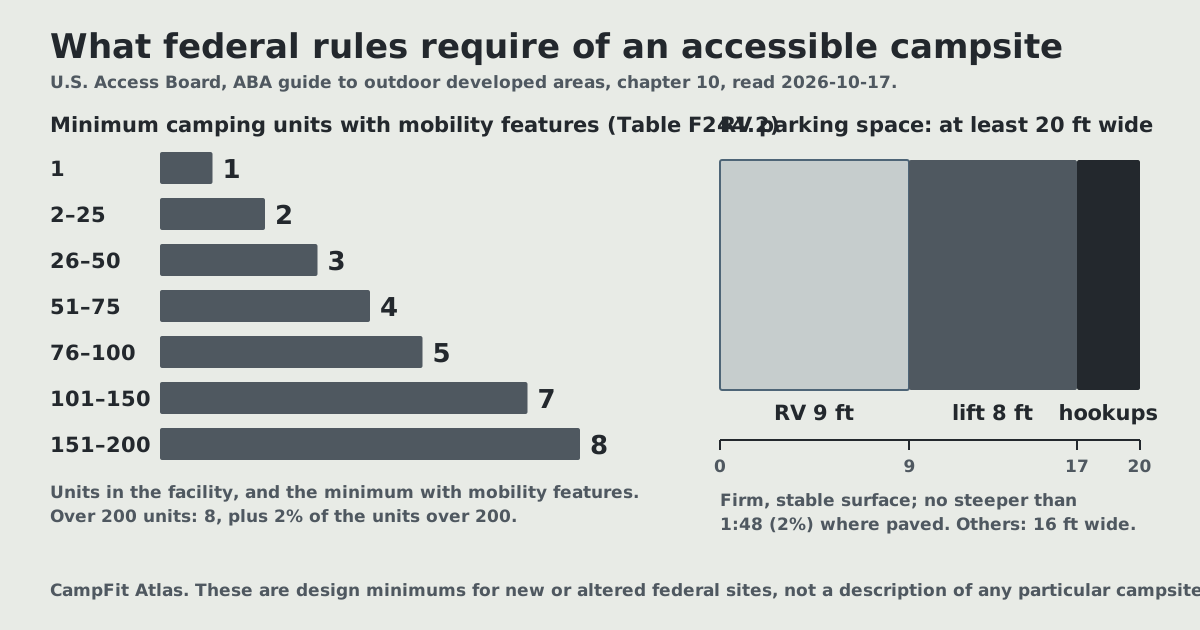
Table F244.2 sets the minimum number of camping units with mobility features.
| Total camping units of that type | Minimum with mobility features |
|---|---|
| 1 | 1 |
| 2 to 25 | 2 |
| 26 to 50 | 3 |
| 51 to 75 | 4 |
| 76 to 100 | 5 |
| 101 to 150 | 7 |
| 151 to 200 | 8 |
| 201 and over | 8, plus 2 percent of the number over 200 |
The table applies separately to each type of camping unit. When a facility is altered or added to, only the altered or added units count until the facility meets the minimum. That means an older campground that has not been altered may have fewer accessible units than the table suggests.
For scale: the NPS lists Upper Pines at 236 sites and Mather at 327. If every site were one type of unit built new, the table would call for 8 plus 2 percent of the excess over 200: about 8.7 for Upper Pines and about 10.5 for Mather. That is a calculation on the table, not a statement of how many accessible sites either campground has, and the campground pages do not publish a count.
Parking spaces for RVs
This is the requirement that matters most for an RV with a wheelchair lift.
| Element | Requirement | Section |
|---|---|---|
| RV parking or pull-up space width | At least 20 feet | 1012.2 |
| Other vehicle parking space width | At least 16 feet | 1012.3 |
| Surface | Firm and stable | 1012.4 |
| Slope, paved or boards | No steeper than 1:48 (2 percent) in any direction | 1012.5 |
| Slope, other surfaces | Up to 1:20 (5 percent) where needed for drainage | 1012.5 |
| Accessible RV dump station pull-up space | At least 20 feet wide | 1011 |
The Access Board explains the 20 feet: a typical RV is 8 feet wide and needs a 9-foot space, a lift needs an additional 8 feet on the passenger side, and utility hookups need an additional 3 feet on the driver's side. Nine plus eight plus three is twenty. The hero figure draws that breakdown to scale.
Note what the table does not include: a length. The guidelines set the width, surface and slope of the space. How long a rig the site accepts is still set by the site's own maximum vehicle length.
Picnic tables, fire rings and other features
| Feature | Requirement |
|---|---|
| Picnic table clear ground space | 36 inches on all usable sides |
| Picnic table wheelchair space | 30 by 48 inches for each 24 linear feet of usable tabletop perimeter |
| Picnic table knee clearance | At least 30 inches wide and 8 inches deep at 27 inches high |
| Picnic table toe clearance | At least 30 inches wide, 17 inches deep and 9 inches high |
| Fire ring, grill, fireplace | 48 by 48 inches of clear ground space; fire-building surface at least 9 inches above the ground |
| Grill cooking surface | 15 to 34 inches above the ground |
| Utility hookups | 30 by 60 inches of clear ground space adjoining the accessible parking or RV pull-up space |
| Tent pad or platform | 48 inches of clear ground space on all usable sides, firm and stable, and able to take stakes or tie-downs |
| Outdoor recreation access route | At least 36 inches clear width |
The guide says a table up to 9 feet long usually needs one wheelchair space and a table of 10 to 20 feet usually needs two. Within a unit with mobility features, at least one of each type of element must comply, and if more than one of a type is provided, at least two must.
Which Recreation.gov fields to read for an RV with a lift
An accessible site alert tells you the site is designated. It does not tell you whether your rig fits it. Read these fields on the site page, in this order.
- Max Vehicle Length and Permitted Equipment. Accessible sites can be short. Watchman C014 is an accessible site with a driveway length of 19, a maximum vehicle length of 19 feet, and permitted equipment that includes a trailer, pickup camper, pop-up and camper van, each up to 19 feet, and no RV entry. Watchman D011, also accessible, lists the same 19-foot figures. Watchman's facility page says its non-electric C and D loop sites do not permit vehicles 19 feet and over, including in combined length.
- Site Width. Watchman C014 lists a site width of 19 and D011 a site width of 22. Neither page gives units, but they sit beside driveway lengths in feet. The pages do not say whether that width is the parking space, the whole site, or something else, so treat it as a lead, not a measurement of the 20-foot RV space the guidelines describe.
- Driveway Surface and Grade. C014 is gravel and D011 is paved. The guidelines require a firm and stable surface and no more than 2 percent slope on paved spaces; a page that lists a grade as "Slight" or omits it tells you less than you need. If the slope matters for your lift, ask the campground.
- Driveway Entry. Back-in or pull-through. A lift on the passenger side needs that side clear when parked, and on a back-in you choose which side faces the site by how you reverse in. Our guide to pull-through vs back-in campsites covers how each type is recorded.
- Hookups. The guidelines require clear ground space at a utility hookup when one is provided. Both accessible Watchman sites read here are non-electric.
Then run your rig through the fit calculator. Set the slide-out depth and body width to your own figures; the calculator's defaults of 8.5 feet across and 3 feet per slide are our editable assumptions, not a specification. Add your lift's deployed width to the passenger side to see how wide a space you really need.
What the verified campgrounds publish about accessible sites
This site keeps a record for each campground whose facility-wide length limit is verified on an official page. None of those official pages, as read for this guide, publishes a count of accessible sites or describes the accessible sites' dimensions.
| Campground | Accessibility on the official facility page |
|---|---|
| Mather, Grand Canyon | No accessibility statement on the Recreation.gov facility page |
| Upper Pines, Yosemite | No accessibility statement on the Recreation.gov facility page |
| Trailer Village, Grand Canyon | NPS page has an Accessibility Information heading with no details under it |
| Fishing Bridge RV Park, Yellowstone | No accessibility statement on the concessioner's page |
| Watchman, Zion (no fit page) | Accessible sites flagged individually on site pages, and some site IDs carry an HC suffix |
That is a gap in what is published, not evidence about what is on the ground. A campground with no statement may have well-built accessible sites; it simply does not describe them on the page. The practical answer is the same everywhere: open the site pages, look for the alert, and contact the campground about the details the page leaves out.
What the listing cannot tell you
A few things matter to an accessible stay and do not appear as fields on the site pages read here:
- The route from the site to the restroom and water. The guidelines require an outdoor recreation access route to connect accessible elements within units with mobility features and the common-use features serving them, but the site page does not describe that route.
- The actual slope of the parking space. "Slight" is a word, not a percentage.
- Whether the space is 20 feet wide. The site width field does not say what it measures.
- Whether the table, fire ring and tent pad comply. The alert says the site is accessible; it does not list which features were built or altered to the standard.
For any of these, call or email the campground before booking. The guidelines tell you what to ask for by name: a 20-foot-wide RV space, a firm and stable surface, a slope no steeper than 2 percent, 36 inches of clear space around the table.
Before you book
- Open each candidate site page and look for the ACCESSIBLE SITE alert.
- Read the maximum vehicle length and permitted equipment, because accessible sites can be short.
- Note the driveway surface, grade, entry type and site width, and ask the campground what the width measures.
- Compare your rig, including the lift's deployed width, with the 20-foot federal minimum.
- Ask about the route to restrooms and water if the page does not describe it.
The federal guidelines say what an accessible camping unit should provide, and the site page says whether a site is designated and how long a rig it takes. Read both before reserving accessible campsites on Recreation.gov.
Sources
- U.S. Access Board: Guide to the ABA Accessibility Standards, Chapter 10: Outdoor Developed Areas, read October 17, 2026.
- Recreation.gov: Watchman Campground and its sites C014, D011, A024 and A022; Upper Pines site 214; Accessibility. All read October 17, 2026.
- Site designations and policies can change; the official page wins. Nothing here is a reservation or an availability claim.
Frequently asked questions
How do I know if a campsite on Recreation.gov is accessible?
Open the individual campsite page. On the Watchman Campground site pages read for this guide, an accessible site shows an alert reading You are about to make a reservation for an ACCESSIBLE SITE, and some accessible sites carry an HC suffix in the site ID in the facility's site list, such as A016HC. The facility page did not explain the suffix, so rely on the alert on the site page rather than the ID alone.
Can anyone book an accessible campsite?
The Watchman site pages read for this guide ask that, if no one in your party needs an accessible site, you consider selecting another site unless it is the only site available. That is the wording on those pages; individual facilities can set their own policy, and Recreation.gov says location-specific policies supersede its site-wide ones.
How wide does an accessible RV campsite parking space have to be?
Under the federal Architectural Barriers Act outdoor guidelines, parking spaces and pull-up spaces for RVs in camping units with mobility features must be at least 20 feet wide. The U.S. Access Board explains the figure as 9 feet for an 8-foot-wide RV, 8 more feet on the passenger side for a lift, and 3 feet on the driver's side for utility hookups. Parking spaces for other vehicles must be at least 16 feet wide.
How many accessible campsites must a federal campground have?
The Access Board's Table F244.2 sets the minimum: 1 for a one-unit facility, 2 for 2 to 25 units, 3 for 26 to 50, 4 for 51 to 75, 5 for 76 to 100, 7 for 101 to 150, 8 for 151 to 200, and for more than 200 units, 8 plus 2 percent of the units over 200. The table applies separately to each type of camping unit.
What makes a campsite picnic table accessible?
The federal outdoor guidelines require 36 inches of clear ground space on the usable sides of a picnic table and a wheelchair space of 30 by 48 inches for each 24 linear feet of usable tabletop perimeter, with knee clearance at least 30 inches wide and 8 inches deep at 27 inches high. In practice, a table up to 9 feet long usually needs one wheelchair space.
Does an accessible campsite have to be longer for an RV?
The guidelines discussed here set width, surface and slope for accessible RV parking spaces, not a length. Length is still governed by the site's own maximum vehicle length and permitted-equipment list. Watchman site C014, an accessible site, lists a 19-foot gravel back-in driveway and a 19-foot maximum vehicle length, so an accessible site can be short.