Pull-Through vs Back-In Campsites: Which Fits Your Rig
Pull-through vs back-in campsites: how Recreation.gov lists each, why a long driveway is not permission, and when a back-in spur still works for a trailer.
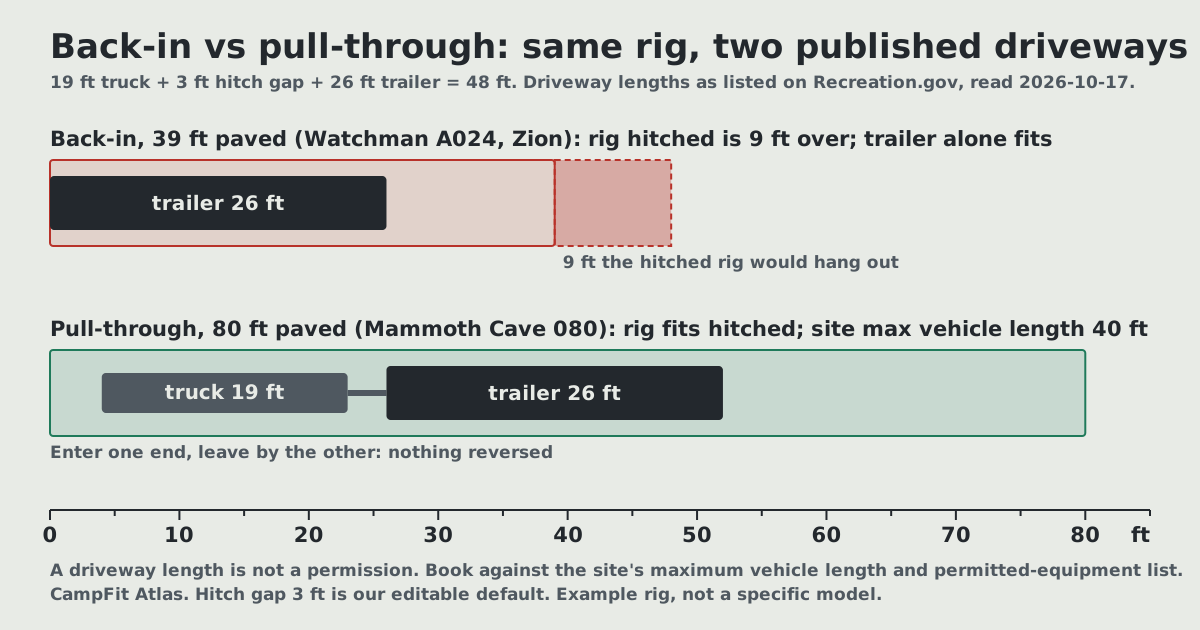
Pull-through vs back-in campsites is the first fork in any RV site search: a pull-through is a driveway you enter at one end and leave by the other, and a back-in is a spur with one opening that you reverse into. Pull-throughs are easier to use and usually longer, but a long pull-through driveway is not the same as permission to park a long rig, and a short back-in can still take your trailer if you are willing to unhitch.
This guide shows how both types are recorded on Recreation.gov, what the figures on each kind of site actually promise, and how to decide which one your rig needs, using site pages read on October 17, 2026.
Pull-through vs back-in campsites, defined
The difference is geometry, and it decides how you get in and out.
A pull-through site is a strip of driveway alongside or between the loop roads, open at both ends. You drive in forward, stop, and later drive out forward. Nothing is reversed, the trailer can stay hitched, and the driveway can be longer than the rig because the exit is ahead of you.
A back-in site is a spur off the loop road, open only at the road end. A trailer has to be reversed into it, and the far end of the spur is a hard stop: trees, a slope, a tent pad, a boulder line. Motorhomes usually reverse in too, so the door and hookups face the site rather than the road.
| Pull-through | Back-in | |
|---|---|---|
| Openings | Two, one at each end | One, at the loop road |
| Reversing needed | No | Yes, for trailers and most motorhomes |
| Can stay hitched | Usually | Only if the spur holds the whole rig |
| Typical driveway | Long, sometimes far longer than the rig | Often short in older campgrounds |
| Door side | Set by direction of travel | Chosen by which way you back in |
| Where common | Purpose-built RV parks | Older campgrounds, tent-and-RV loops |
Neither type is better in general. A pull-through suits a long rig, a driver who does not want to reverse a trailer into trees, and a one-night stop where unhitching is a nuisance. A back-in suits a shorter rig, a stay long enough to unhitch, and campgrounds where nearly every site is a back-in anyway.
How Recreation.gov records the entry type
On a Recreation.gov campsite page, the entry type lives in the driveway block. The field names below are the ones those pages use, and the values come from site pages read on October 17, 2026.
| Field | What it says | Example value |
|---|---|---|
| Driveway Entry | Back-in or Pull-Through | "Back-in" at Watchman A024; "Pull-Through" at Mammoth Cave 080 |
| Driveway Length | The measured spur, in feet | 39 at Watchman A024; 80 at Mammoth Cave 080 |
| Driveway Surface | Paved, gravel or similar | Paved at both |
| Driveway Grade | How level it is | "Slight" at Watchman A024 |
| Max Vehicle Length | The longest vehicle the site accepts | 39 at Watchman A024; 40 at Mammoth Cave 080 |
| Permitted Equipment | A length per equipment type | RV, trailer and fifth wheel each 39 ft at Watchman A024 |
The entry type tells you how you will move. The other fields tell you whether you are allowed to be there with what you are towing. Read all of them before you book.
Why a long pull-through is not permission
The figure at the top of this page uses two real driveways. The pull-through is site 080 at Mammoth Cave Campground in Mammoth Cave National Park, which Recreation.gov lists as a paved pull-through with a driveway length of 80 and a maximum vehicle length of 40. The page also says the pad is level but the site has a significant slope, and that it is not recommended for tents.
That is the trap in one listing. Eighty feet of pavement and a 40-foot maximum vehicle length are both on the same page, and the 40 is the number the reservation is made against. A pull-through driveway is often long because of where the loop roads run, not because the campground wants 80-foot rigs on it.
What the 40 governs is not spelled out on the page. It may be read as a limit on each vehicle, in which case a 19-foot truck and a 26-foot trailer each pass, or as a limit on the whole rig, in which case a 48-foot combination does not. When a site page leaves that open, contact the campground before booking rather than settling it in your favour.
Theodore Roosevelt National Park shows the same pattern from a different angle. Site 029 at Cottonwood Campground is a gravel pull-through with a site length of 114, a maximum vehicle length of 46, and permitted-equipment entries for an RV, a trailer and a fifth wheel each at 45 feet. The site is more than twice as long as anything it allows.
So for a pull-through, the driveway length answers "can I drive through without hitting anything" and the equipment list answers "am I allowed to book this with my rig". Only the second one gets you a valid reservation. Our guide to campground driveway length vs RV length covers that distinction field by field.
Why a short back-in is not always a no
A back-in spur shorter than your hitched rig can still work if you unhitch and park the trailer on its own.
Site A024 at Watchman Campground in Zion is a paved back-in with a slight grade, a driveway length of 39 and a maximum vehicle length of 39. Its permitted-equipment list includes an RV, a trailer and a fifth wheel, each at 39 feet. A 19-foot truck plus the calculator's default 3-foot hitch gap plus a 26-foot trailer comes to 48 feet, which is 9 feet longer than the spur. Hitched, it does not fit.
Unhitched, the trailer is 26 feet against 39 feet of driveway, which leaves 13 feet, more than the 5-foot margin this site uses by default. The margin is our editorial assumption, not a published rule, and you can change it in the fit calculator. The calculator's unhitch checkbox runs exactly this case and redraws the diagram with only the trailer on the driveway.
The catch is the tow vehicle. Unhitching only helps if the truck is allowed to park somewhere. Watchman allows two passenger vehicles, or one RV or camping trailer and its associated tow vehicle, or four motorcycles per site, according to the A024 page, and Recreation.gov's facility page for Watchman Campground gives the loop rules. Yosemite's campground rules say a trailer does not count against the two-vehicle limit as long as it fits on the parking pad, and that all vehicles must be parked on a parking pad (NPS Yosemite camping regulations). Rules like these decide whether the unhitched plan is legal, so read them for the campground you are booking.
What national park campgrounds publish about entry type
The campgrounds on this site fall into two groups, and the split is mostly about when and why they were built.
Purpose-built RV areas lean pull-through. The National Park Service describes Trailer Village at Grand Canyon as having paved pull-through sites that can accommodate vehicles up to 50 feet long (NPS Trailer Village). At Fishing Bridge RV Park in Yellowstone, the concessioner says the Upper Loop has 172 paved sites from 40 to 95 feet long and that most have pull-through drives (Yellowstone National Park Lodges).
Mixed tent-and-RV campgrounds lean back-in. Every Watchman and Upper Pines site page read for this site lists a back-in entry: Watchman A024 and A022, Watchman C014 and D011, and site 214 at Upper Pines in Yosemite. That is a sample of pages, not a census of either campground, so treat it as a pattern to check rather than a rule.
Fishing Bridge's Lower Loop is the useful in-between case. The concessioner describes 30- to 35-foot gravel back-in sites wide enough to park a tow vehicle or an extra vehicle, and 30-foot gravel back-in sites that are single-width and will not take an extra vehicle. Two back-ins of similar length can therefore differ on whether your truck can stay on the site, which matters more than the entry type itself.
Which one your rig needs
Run these in order. The first one that settles the question is the answer.
- Find your combined length. Truck plus hitch gap plus trailer, or coach plus tow bar plus car, or truck plus fifth wheel minus the bed overlap. Our guide on how to measure RV length shows where each tape measurement starts and stops.
- Compare it with the campground's published maximum. If the campground caps RVs or trailers below your unit length, the entry type does not matter. The campground pages list the figure and the sentence it came from.
- Decide whether you will unhitch. If yes, a back-in only has to hold the trailer, plus whatever margin you want, and the site rules have to allow the tow vehicle somewhere. If no, the site has to hold the whole rig, which in most campgrounds means a pull-through.
- Read the site's equipment list. On either type, book the equipment you will arrive with at the length you will arrive with. Upper Pines site 214's page warns that arriving with different equipment than you booked means you will likely not fit and will be turned away.
- Check the surface and grade. A gravel spur with a "Slight" grade and a paved pad with a "significant slope in the site" are different nights. Levelling blocks fix a few inches, not a hillside.
| Your situation | Usually works | Check first |
|---|---|---|
| Long trailer, one-night stop, no wish to unhitch | Pull-through | Max vehicle length and equipment list, not driveway length |
| Trailer, multi-night stay, happy to unhitch | Back-in at least trailer length plus margin | Whether the tow vehicle may park on the site |
| Motorhome, no towed car | Either | Max RV length on the facility and site pages |
| Motorhome towing a car | Back-in with the car parked separately, or pull-through | Vehicle-per-site limit and whether the car counts |
| Fifth wheel | Pull-through, or back-in with room for the truck to swing | Equipment list includes "Fifth Wheel" at your length |
Reversing into a back-in: what the spur does not tell you
A back-in driveway length is measured along the spur. It does not describe the swing you need to get there. Three things the listing leaves out:
The loop road width and what is opposite. Reversing a trailer into a spur needs room for the tow vehicle to swing across the road. Trees, posts or another site's spur opposite the entrance shorten that room.
The angle of the spur. A spur angled toward your direction of travel is easier than one at a right angle. Site pages do not record the angle; campground maps sometimes show it.
Width at the mouth. Watchman A024 lists a site width of 14. The calculator's defaults put a body at 8.5 feet across before mirrors or slides, which are our editable assumptions and not a specification. Measure your own rig and compare.
None of this shows up as a number you can filter on. It is the reason the margin in the calculator exists, and the reason a first-time trailer driver may reasonably pay more for a pull-through even when a back-in technically fits.
Mistakes that send people back to the loop road
Booking a pull-through by driveway length. The equipment list is the permission. Mammoth Cave 080's 80-foot driveway and 40-foot maximum vehicle length show how far apart they can be.
Assuming a back-in is too short without considering unhitching. If you are staying more than a night, the trailer-only length is the number that has to fit, and the site rules decide where the truck goes.
Ignoring a 0. A driveway length of 0, as on Upper Pines site 214, means the field was never filled in, not that there is no driveway. Use the maximum vehicle and equipment lengths instead.
Treating the facility page as the site page. A campground can have both entry types. Fishing Bridge has pull-throughs in the Upper Loop and back-ins in the Lower Loop, and the two loops carry different lengths.
The short version
A pull-through saves you from reversing and usually holds a hitched rig, but its driveway figure is not the limit you book against. A back-in is usually shorter, often fine for a trailer you are willing to unhitch, and governed by the same equipment list. Measure your rig, read the maximum vehicle length and the permitted-equipment line for the specific site, and you can choose between pull-through vs back-in campsites on the numbers rather than on hope.
Sources
- Recreation.gov: Watchman Campground site A024, Watchman Campground, Mammoth Cave Campground site 080, Cottonwood Campground site 029, Theodore Roosevelt National Park and Upper Pines site 214, read October 17, 2026.
- National Park Service, Grand Canyon: Trailer Village RV Campground, last updated September 5, 2024, read October 17, 2026.
- National Park Service, Yosemite: Camping regulations, last updated August 1, 2025, read October 17, 2026.
- Yellowstone National Park Lodges (authorized concessioner): Fishing Bridge RV Park, read October 17, 2026.
- Site fields change; the official page wins. Nothing here is a reservation or an availability claim.
Frequently asked questions
What is the difference between a pull-through and a back-in campsite?
A pull-through campsite is a driveway with an entrance at one end and an exit at the other, so you drive in forward and leave forward without reversing. A back-in campsite has one opening on the loop road, so a trailer has to be reversed into it and a motorhome usually is. Recreation.gov records this in a field called Driveway Entry, with values such as Back-in and Pull-Through.
Is a pull-through site always long enough for my rig?
No. The driveway is often long, but the site still sets a maximum vehicle length. Recreation.gov lists Mammoth Cave Campground site 080 as an 80-foot paved pull-through with a 40-foot maximum vehicle length, so the published permission is about half the length of the pavement. Book against the maximum vehicle length and the permitted-equipment list, not the driveway figure alone.
Can I fit a long truck and trailer on a back-in site?
Sometimes, if you unhitch. Watchman site A024 in Zion is a 39-foot paved back-in, too short for a 48-foot truck and trailer hitched together but long enough for a 26-foot trailer on its own. Whether the tow vehicle can then park on the same site depends on that site's rules; Watchman allows one RV or camping trailer and its associated tow vehicle per site.
Which side does the door open on in a pull-through site?
It depends on the direction of travel through the site. Recreation.gov notes this on some site pages: Cottonwood Campground site 029 in Theodore Roosevelt National Park is listed as a right-hand pull-through on which the door opens on the picnic table side. On a back-in site you can choose by which way you back in, within what the spur allows.
Do national park campgrounds have pull-through sites?
Some do, mostly in purpose-built RV areas. The National Park Service describes Trailer Village at Grand Canyon as having paved pull-through sites for vehicles up to 50 feet, and the concessioner says most Upper Loop sites at Fishing Bridge RV Park in Yellowstone have pull-through drives. Older campgrounds such as Upper Pines in Yosemite list back-in spurs on the site pages read for this site.